Why This Research Matters
Human societies have always searched for ways to understand uncertainty, make better decisions and find meaning in life. Long before modern psychology, behavioural economics and artificial intelligence emerged, civilizations developed sophisticated knowledge systems to study human nature, time, relationships and decision-making. Among these, astrology, numerology, palmistry and other Indic and occult traditions occupy a unique place.
While these disciplines continue to influence millions of people worldwide, they are often viewed either as unquestionable beliefs or dismissed without serious academic examination. This leaves an important gap—understanding these systems as structured bodies of knowledge that shaped human behaviour, cultural identity and civilisational thinking for centuries.
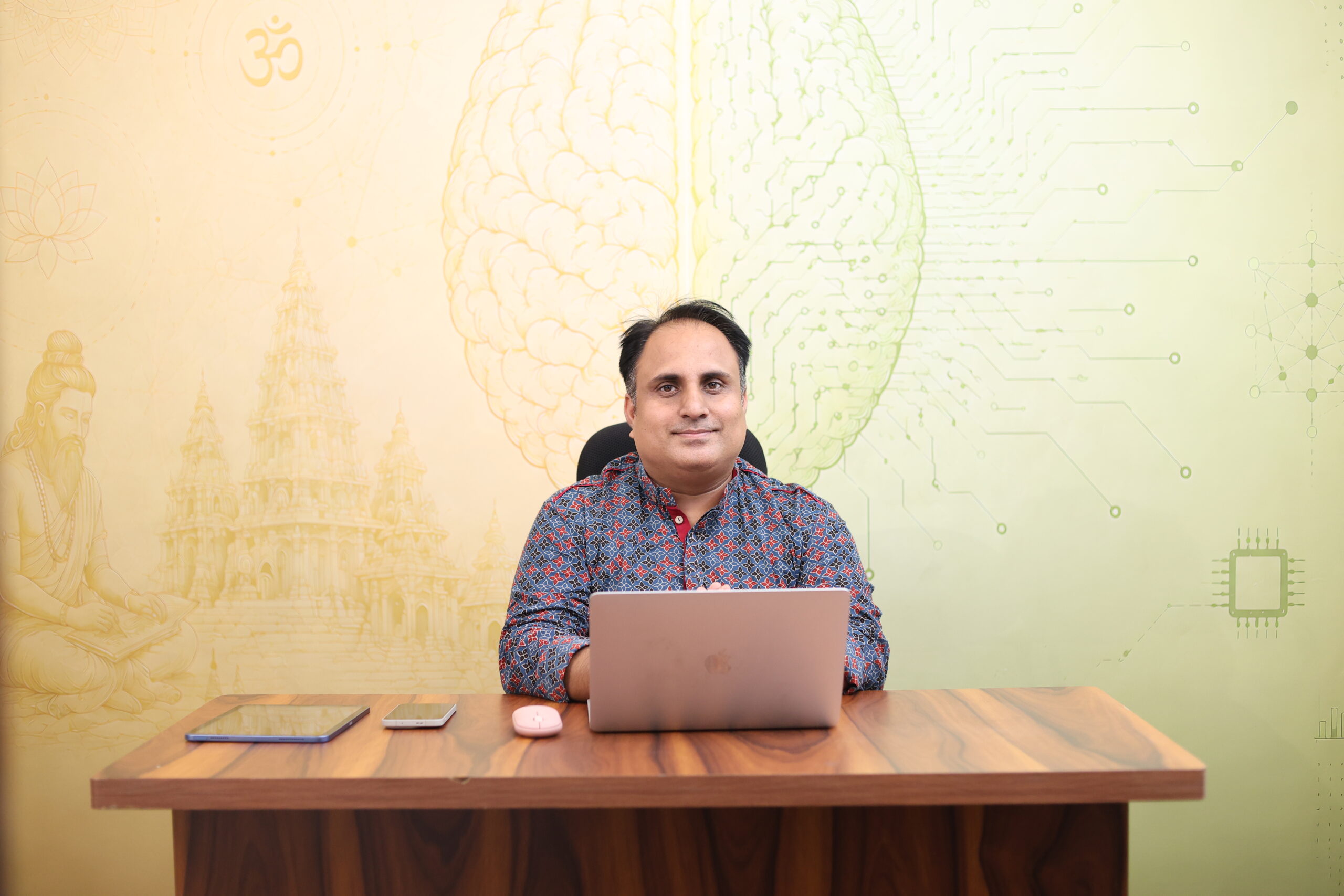
The research journey of Sidhharrth S Kumaar is built around addressing this gap.
Rather than asking whether astrology “works” in isolation, his research investigates how these knowledge systems were developed, why they endured across civilizations, how they continue to influence human behaviour, and how they can be responsibly interpreted in the age of Artificial Intelligence.
Research Philosophy
At the heart of Sidhharrth’s work lies a simple belief:
Ancient wisdom should neither be blindly accepted nor casually rejected. It should be studied, documented and understood through rigorous, interdisciplinary inquiry while remaining faithful to its classical foundations.
His work therefore combines three complementary perspectives:
- Classical scholarship rooted in original Indic texts.
- Behavioural and cultural sciences to understand how symbolic systems influence human behaviour.
- Artificial Intelligence to explore how ancient knowledge can be structured, preserved and responsibly applied in the digital age.
Instead of modernising classical wisdom by changing its principles, his objective is to understand its original intent and reinterpret its applications for contemporary society.
The Three Pillars of Research
1. Understanding Astrology and Occult Sciences as Knowledge Systems
The first pillar of Sidhharrth’s research examines astrology, numerology, palmistry and traditional energy sciences as comprehensive systems of knowledge rather than isolated predictive tools.
His work studies how these disciplines were historically used to understand:
- Human personality
- Decision-making
- Relationships
- Leadership
- Health and wellbeing
- Timing and life events
- Civilisational thinking
Drawing from classical Jyotisha literature and traditional occult sciences, his research seeks to preserve the philosophical depth of these disciplines while documenting their underlying principles in a structured manner.
2. Understanding Human Behaviour Through Culture and Symbolism
The second pillar focuses on human behaviour.
Rather than asking whether people simply believe in astrology, Sidhharrth’s research explores why symbolic systems survive across generations and continue to influence individuals and societies.
His work examines:
- Cultural conditioning
- Symbolic cognition
- Identity formation
- Ritual psychology
- Behavioural decision-making
- Cultural evolution
- Civilisational memory
This direction of research views astrology and related traditions not merely as predictive sciences but also as cultural frameworks that shape how people interpret uncertainty, relationships, success, failure and identity.
His published commentary in Behavioral and Brain Sciences (Cambridge University Press) reflects this broader perspective by examining symbolic super-attractors and the enduring influence of cultural practices on human behaviour.
3. Ancient Wisdom in the Age of Artificial Intelligence
The third pillar explores one of the newest frontiers in Indian Knowledge Systems.
Instead of asking whether Artificial Intelligence can replace astrologers, Sidhharrth’s work investigates:
- How can classical astrological knowledge be represented in structured formats?
- How can AI preserve rather than distort traditional wisdom?
- How can knowledge graphs and decision frameworks organise classical rules?
- How can Human-AI collaboration improve consistency while retaining expert judgement?
- How can personalised guidance remain explainable, transparent and rooted in authentic sources?
His long-term vision is to create responsible AI frameworks that make ancient knowledge more accessible without compromising its philosophical integrity.
Major Research Themes
Over the years, his work has evolved around several interconnected themes:
- Indian Knowledge Systems (IKS)
- Classical Jyotisha
- Chaldean Numerology
- Palmistry and Behavioural Observation
- Traditional Energy Sciences
- Behavioural Sciences
- Cultural Psychology
- Symbolic Cognition
- Ritual and Cultural Conditioning
- Identity Formation
- Human Decision-Making
- Artificial Intelligence for Classical Knowledge
- Human-AI Collaboration
- Explainable AI in Astrology
- Preventive, Personalised and Proactive Guidance Frameworks
Together, these themes represent a broader attempt to understand ancient wisdom as an evolving body of knowledge relevant to both classical scholarship and contemporary society.
Classical Foundations
A defining characteristic of Sidhharrth’s research is its emphasis on primary sources.
His work draws inspiration from classical Jyotisha literature and traditional Indic knowledge systems, studying original principles before examining their modern applications. Rather than relying solely on popular interpretations, his research seeks to understand the philosophical intent behind classical doctrines and their evolution over time.
This commitment to classical scholarship forms the foundation upon which his behavioural and AI-related research is built.
Academic Contributions
Sidhharrth S Kumaar has actively presented his research at leading management institutes, universities and academic conferences across India, contributing to interdisciplinary discussions on Indian Knowledge Systems, behavioural sciences and management.
His research has been presented at institutions including:
- Indian Institute of Management Ahmedabad (IIM Ahmedabad)
- Indian Institute of Management Nagpur (IIM Nagpur)
- Indian Institute of Management Bodh Gaya (IIM Bodh Gaya)
- Indian Institute of Management Ranchi (IIM Ranchi)
- Indian Institute of Technology Madras (IIT Madras)
- Delhi University (DU)
- Central Sanskrit University (CSU)
- Shri Lal Bahadur Shastri National Sanskrit University, New Delhi
- All India Oriental Conference (AIOC)
In addition, he has presented at numerous national and international conferences organised by UGC-recognised universities and academic institutions.
These presentations span themes including Indian Knowledge Systems, behavioural sciences, management, consumer behaviour, cultural studies, artificial intelligence, astrology and numerology.
Publications
Alongside conference presentations, Sidhharrth contributes to academic literature through journal publications and scholarly commentaries.
His published commentary in Behavioral and Brain Sciences (Cambridge University Press) explores symbolic super-attractors as a framework for understanding why cultural traditions—including those rooted in Indic knowledge systems—continue to shape human identity and collective behaviour.
He has also contributed to the International Journal of Jyotish, expanding scholarly discussions around classical astrology and related Indic disciplines.
Together, these publications reflect a broader commitment to bringing Indian Knowledge Systems into mainstream interdisciplinary research.
Translating Research into Practice
For Sidhharrth, research is valuable only when it improves practice.
His academic work informs consultation frameworks, educational programmes, decision-support models and innovations that integrate classical astrology, Chaldean numerology, palmistry and traditional energy sciences. Whether applied to leadership, relationships, branding, wellbeing or lifestyle choices, his objective remains the same: to translate research into practical, evidence-informed frameworks while preserving the integrity of classical traditions.
Vision for the Future
Sidhharrth’s long-term research vision extends beyond individual publications or conference presentations.
He seeks to contribute to a future where Indian Knowledge Systems are studied with the same intellectual rigour as other established academic disciplines. His work aims to build structured frameworks that connect classical scholarship, behavioural sciences and Artificial Intelligence, ensuring that ancient wisdom is preserved, documented and responsibly applied for future generations.
Rather than positioning tradition and technology as opposing forces, his research argues that the two can complement one another. When classical knowledge is interpreted with scholarly rigour and supported by responsible technological innovation, it has the potential to contribute meaningfully to our understanding of human behaviour, decision-making and cultural continuity in the twenty-first century.