Introduction: Kāmaśāstra Is Far Greater Than the Kāmasūtra Alone
The popular imagination often reduces India’s Kāmaśāstra tradition to Vātsyāyana’s Kāmasūtra and then reduces the Kāmasūtra itself to a catalogue of sexual positions. Both assumptions are incomplete. Kāmaśāstra is a much wider intellectual tradition concerned with kāma—desire, pleasure, attraction, beauty, sensory refinement, courtship, companionship, intimacy and emotional fulfilment—as one of the legitimate aims of human life. It studies how people attract one another, form relationships, experience pleasure, cultivate refinement, negotiate marriage and manage the emotional and material realities surrounding intimacy.
In the classical Indian understanding of the puruṣārthas, human life is not governed by desire alone. Kāma must be considered alongside dharma, or ethical and social responsibility, and artha, or material security and worldly capability. Vātsyāyana’s achievement was therefore not the invention of a disconnected sexual manual. He inherited an already developed field of knowledge, gathered its scattered branches and reorganised them into the earliest complete Kāmaśāstra text that survives today.
To understand that tradition properly, three interconnected groups must be studied. The first is the direct lineage recorded in the opening of the Kāmasūtra, beginning with Prajāpati and proceeding through Nandī, Śvetaketu, Bābhravya and the seven specialist teachers before reaching Vātsyāyana. The second consists of later authors and commentators who interpreted, reorganised or extended Kāmaśāstra for new historical settings. The third includes poets, aestheticians and literary thinkers who were not necessarily writers of technical Kāmaśāstra, but whose work illuminates love, longing, beauty, union, separation and relationship psychology.
A Necessary Note on Tradition and History
The earliest part of the Kāmaśāstra lineage combines sacred genealogy with intellectual history. Prajāpati and Nandī belong primarily to the tradition’s mythic account of its own origin. Śvetaketu and the early teachers may preserve the memory of older schools, but their independent Kāmaśāstra works are no longer available. Vātsyāyana is the principal source through whom their names and specialisations are known. The lineage should therefore be respected as the tradition presents it without treating every biographical detail or chapter count as a modern, independently verified historical fact. From Vātsyāyana onward, surviving texts and manuscripts provide a firmer basis for literary history, although the dates and identities of several later authors continue to be debated.
Part One: The Direct Kāmaśāstra Lineage
Prajāpati: The Primordial Source of Dharma, Artha and Kāma
The traditional history narrated by Vātsyāyana begins with Prajāpati, the Lord of Creatures. Prajāpati is said to have formulated an enormous body of knowledge covering the regulation and fulfilment of human life through dharma, artha and kāma. Within this sacred genealogy, Svāyambhuva Manu separated and expounded the teachings concerning dharma, Bṛhaspati organised those concerning artha, and Nandī developed the portion devoted to kāma. Prajāpati’s position is therefore foundational: desire was not imagined as an accidental or shameful interruption of life, but as one part of an integrated civilisational framework. This account does not function like a modern publication history; it gives Kāmaśāstra sacred legitimacy by placing it within a unified science of human flourishing.
Nandī: The First Great Expositor of Kāma
Nandī, the attendant and follower of Śiva, is traditionally credited with extracting the teachings on kāma and arranging them into one thousand chapters. Some later retellings call him Nandikeśvara, but the essential idea remains that the knowledge of pleasure was transmitted through a figure closely connected with Śiva. The thousand-chapter attribution communicates breadth rather than merely numerical scale: early Kāmaśāstra was imagined as encompassing attraction, sensory life, social conduct, intimacy, aesthetics and methods of cultivating pleasure. No independent text by Nandī survives, and his role belongs principally to sacred intellectual genealogy. Nevertheless, he represents the moment at which kāma becomes a specialised and teachable field of knowledge.
Śvetaketu Auddālaki: The First Human Systematiser
Śvetaketu Auddālaki, the son of Uddālaka, is said to have condensed Nandī’s one thousand chapters into five hundred. He is significant because the tradition moves through him from divine transmission to human scholarship. Śvetaketu is also a renowned name in Upaniṣadic literature, and later tradition commonly connects the Kāmaśāstra teacher with that philosophical figure. Historical caution is necessary, however, because the surviving evidence cannot conclusively establish that every reference to Śvetaketu concerns one and the same individual. Within the Kāmaśāstra lineage, his intellectual role is clear: he made a vast inherited corpus more organised and accessible while retaining its status as a serious śāstra.
Bābhravya of Pañchāla: The Architect of the Seven-Part System
Bābhravya, associated with the region of Pañchāla, reduced Śvetaketu’s five hundred chapters to one hundred and fifty and arranged the subject into seven divisions. These divisions covered general principles, intimate union, courtship and acquiring a bride, the conduct of wives, relations involving other men’s wives, courtesans and esoteric or supplementary practices. This seven-part architecture became the structural foundation inherited by Vātsyāyana. Bābhravya is therefore more than an abridger: he is the great organiser of the field. His original work has not survived as a complete independent text, but its conceptual map remains visible throughout the Kāmasūtra and through the specialised branches developed by later teachers.
Cārāyaṇa: Teacher of the General Principles of Kāma
Cārāyaṇa developed the first of Bābhravya’s seven divisions, the section concerned with general principles. This branch provided the intellectual and cultural foundation of Kāmaśāstra: the place of kāma in a well-lived life, its relationship with dharma and artha, the education of the cultivated urban person and the arts and social abilities required for refined companionship. Cārāyaṇa’s contribution reminds modern readers that Kāmaśāstra begins with a philosophy and discipline of living, not with physical technique. His independent treatise is lost, and his thought survives primarily through Vātsyāyana’s citations, agreements and disagreements with earlier teachers.
Suvarṇanābha: Specialist in Affection and Intimate Union
Suvarṇanābha elaborated the second division, devoted to intimate union. The subject encompassed the many expressions through which attraction becomes embodied, including embraces, kisses, affectionate touch, the development of arousal, mutual responsiveness and varieties of sexual union. His specialisation demonstrates that classical Indian thinkers treated intimacy as a progressive language of communication rather than as a single isolated act. Vātsyāyana cites Suvarṇanābha’s opinions while sometimes comparing them with those of other schools. Because Suvarṇanābha’s own work is no longer extant, the Kāmasūtra is the principal window into his place in the tradition.
Ghoṭakamukha: Teacher of Courtship and the Acquisition of a Bride
Ghoṭakamukha was associated with the third division, traditionally concerned with obtaining a maiden or bride. In its historical setting, this included the selection of a compatible partner, building familiarity, winning confidence, employing intermediaries, navigating family structures and moving from attraction toward marriage. The ancient social framework was very different from contemporary ideas of partnership, and some assumptions in the material require critical examination today. Even so, Ghoṭakamukha’s branch shows that Kāmaśāstra regarded courtship as a field of timing, communication, emotional intelligence and social understanding rather than merely physical attraction.
Gonardīya: Teacher of Marriage and Household Partnership
Gonardīya developed the fourth division, dealing with wives and the organisation of married life. This branch examined household responsibilities, the relationship between spouses, domestic authority, emotional conduct and the complications created by plural marriage in elite ancient society. It offers evidence about the historical household, but it should not be mistaken for a timeless prescription for modern relationships. Its continuing value lies in demonstrating that Kāmaśāstra extended beyond courtship and sexual union into the maintenance of partnership, the management of expectations and the everyday environment in which intimacy either grows or deteriorates.
Goṇikāputra: Analyst of Forbidden and Socially Complicated Desire
Goṇikāputra was connected with the fifth division, concerning relationships with other men’s wives. The presence of this material is one reason Kāmaśāstra must be read historically and ethically rather than romanticised without discrimination. Vātsyāyana records socially real behaviours, risks, strategies and power relations even when the conduct under discussion conflicts with dharma or produces danger. Goṇikāputra’s branch can therefore be studied as an analysis of secrecy, temptation, infidelity, social vulnerability and the consequences of transgressive desire. A responsible modern interpretation must reject coercion, deception and exploitation while examining what the material reveals about human psychology and ancient society.
Dattaka: The Authority on Courtesans and Relationship Economics
Dattaka separately developed the sixth division, reportedly at the request of the courtesans of Pāṭaliputra. This origin story is particularly important because it associates the production of knowledge with professional women who possessed social, artistic and economic expertise. The resulting branch discusses how courtesans selected patrons, evaluated affection and financial benefit, maintained relationships, recognised declining interest, managed separation and considered reconciliation. Although shaped by a particular historical institution, the material contains sophisticated observations about emotional labour, economic negotiation, attachment, self-interest and power. Dattaka’s independent work is lost, but much of its intellectual substance appears to have entered the sixth book of Vātsyāyana’s compilation.
Kucumāra: Specialist in Erotic Esoterica and Attraction Practices
Kucumāra developed the seventh division, often described as esoteric or supplementary practices. Its historical topics include preparations intended to increase attraction or potency, bodily care, recipes, aphrodisiac claims and techniques for influencing desire. Some of these materials overlap with older medical, botanical, magical and ritual cultures. They cannot automatically be treated as safe or scientifically validated therapies, and potentially harmful or manipulative practices must not be revived uncritically. Kucumāra’s inclusion nevertheless reveals the broad boundaries of premodern Kāmaśāstra, which incorporated the body, appearance, fragrance, confidence, perceived vitality and the search for personal magnetism.
Vātsyāyana Mallanāga: The Great Synthesiser of Kāmaśāstra
Vātsyāyana Mallanāga brought these dispersed schools into the compact work known as the Kāmasūtra. His date remains debated, although the surviving text is commonly placed in the early centuries of the Common Era, often around the third century. He did not claim to invent the science of kāma. Instead, he compared inherited teachings, preserved disagreements among earlier authorities, applied observation and produced a manageable synthesis of a once much larger literature. His seven books address the place of pleasure in life, cultured living and the sixty-four arts, courtship, marriage, intimacy, courtesans, socially complicated desire and supplementary practices. The Kāmasūtra survives not because it speaks only about sex, but because it presents desire as a subject involving education, aesthetics, psychology, society, money, ethics and power. The opening lineage and allocation of the seven specialist branches can be read in the first chapter of the surviving text.
Part Two: Later Authors and Commentators
Yaśodhara: The Author of the Jayamaṅgalā Commentary
Yaśodhara composed the Jayamaṅgalā, the most influential surviving Sanskrit commentary on Vātsyāyana’s Kāmasūtra. Usually placed around the twelfth or thirteenth century, the commentary explains compressed sūtras, clarifies difficult vocabulary, identifies earlier opinions and supplies the conceptual links that a terse aphoristic text often leaves unstated. Yaśodhara is indispensable because every translation of a sūtra already involves interpretation, and his commentary preserves how a learned premodern reader understood the work. He does not merely repeat Vātsyāyana; he evaluates meaning, provides examples and occasionally broadens the relevance of passages beyond their immediate setting. A Sanskrit edition containing the Jayamaṅgalā is available through this archival manuscript edition.
Kokkoka: The Author of Ratirahasya or Koka Śāstra
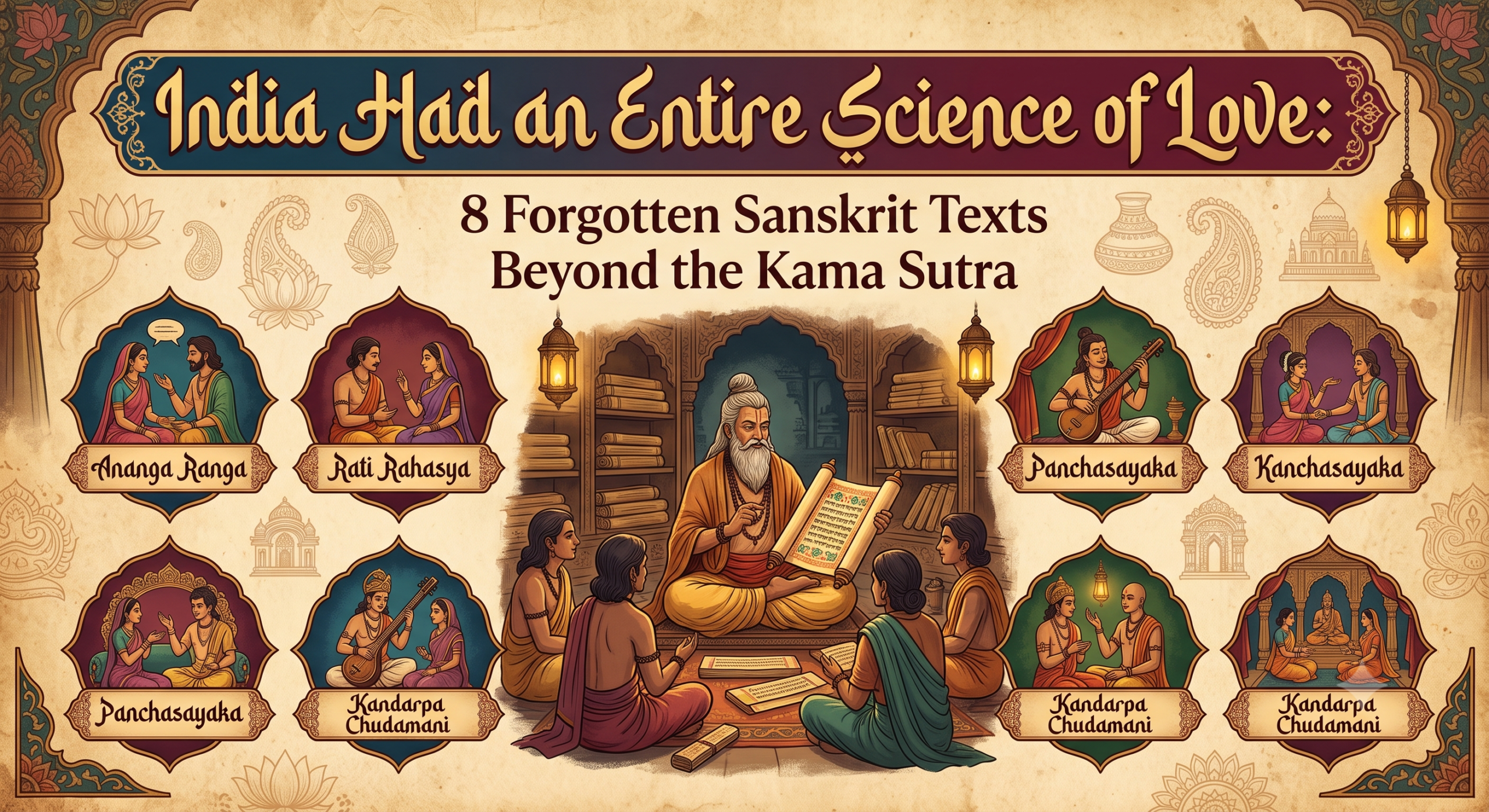
Kokkoka, whose date is uncertain but who belongs to the medieval Kāmaśāstra tradition, authored the Ratirahasya, widely known as the Koka Śāstra. Written in verse and organised into fifteen chapters, it became one of the most influential works on love and intimacy after the Kāmasūtra. Kokkoka drew upon Vātsyāyana and other authorities while reshaping the material around classifications of partners, compatibility, timing, bodily characteristics, courtship and methods of sustaining attraction. The work reflects a different historical world and must not be treated as a simple paraphrase of Vātsyāyana. Its popularity also explains why the name “Koka Śāstra” sometimes became a general label for Indian erotic literature. A full historical translation can be consulted in the archived Ratirahasya of Pandit Kokkoka.
Padmaśrī: The Buddhist Author of Nāgarasarvasva
Padmaśrī, a Buddhist scholar generally associated with the medieval period around the tenth or eleventh century, wrote the Nāgarasarvasva. The title may be understood as a compendium for the cultivated urban person, and the text extends the world of Kāmaśāstra into grooming, ornaments, fragrances, sensory refinement, partner classification and the material culture of pleasure. Its invocations and intellectual setting demonstrate that Kāmaśāstra was not confined to a single sectarian identity. Padmaśrī adapted earlier knowledge for a new social environment, showing how desire was connected with urbanity, luxury, personal presentation and cultivated behaviour. His work is especially valuable for studying how medieval authors transformed the older ideal of the nāgaraka, the sophisticated city-dweller.
Jyotirīśvara Ṭhākura: The Maithila Author of Pañcasāyaka
Jyotirīśvara Ṭhākura, also known by the honorific Kaviśekharācārya, was a major Maithila intellectual active around the early fourteenth century. His Pañcasāyaka, or “Five Arrows of Kāma,” organised Kāmaśāstra material into five sections and drew upon earlier authorities including Vātsyāyana and Kokkoka. The work deals with attraction, compatibility, bodily and emotional characteristics, preparations associated with pleasure and the arts of intimate life. Jyotirīśvara is especially significant for the intellectual history of Bihar and Mithila because he demonstrates that the region was an important centre not only of logic, ritual, literature and philosophy but also of systematic writing on kāma. His contribution connects the pan-Indian Kāmaśāstra tradition with the sophisticated courtly culture of medieval Mithila.
Kalyāṇamalla: The Author of Anaṅgaraṅga
Kalyāṇamalla composed the Anaṅgaraṅga, generally dated to the fifteenth or sixteenth century. The title evokes the “stage” or arena of the bodiless god of love, Anaṅga, a name of Kāma. The work became exceptionally influential because it presented complex material in a comparatively accessible form and gave sustained attention to maintaining attraction within marriage. It discusses compatibility, different temperaments, the cultivation of pleasure and the problem of familiarity reducing desire between long-term partners. Although it inherits classifications and assumptions that require historical scrutiny, its central concern—that intimacy needs knowledge, attentiveness and renewal—helps explain its continuing recognition. The Anaṅgaraṅga is a later independent manual, not a chapter of the Kāmasūtra.
Jayadeva of the Ratimañjarī Tradition: A Concise Voice on Love
A short Kāmaśāstra work called the Ratimañjarī, or “Garland of Love,” is traditionally attributed to an author named Jayadeva. It is a compact metrical treatment, commonly described as containing approximately 125 verses, that condenses themes concerning attraction, bodily classification and intimate union into an elegant literary form. The identity of this Jayadeva is not securely established, and he should not automatically be equated with the celebrated twelfth-century author of the Gītagovinda. That distinction is vital for responsible scholarship: “Jayadeva” is not sufficient evidence that two works belong to the same historical person. Even with this uncertainty, the Ratimañjarī belongs within the later reception and condensation of Kāmaśāstra.
Guṇākara: The Author of Smarapradīpikā
Guṇākara, identified in the textual tradition as the son of Vācaspati, is credited with the Smarapradīpikā, or “Lamp of Love.” The work is commonly described as a concise manual of roughly four hundred verses. It draws together doctrines of attraction and pleasure while also touching subjects beyond narrowly defined intimacy, reflecting the encyclopaedic tendencies of medieval Sanskrit writing. Guṇākara’s importance lies in showing how authors continued to abbreviate, versify and reorganise Kāmaśāstra so that it could circulate in new educational and courtly settings. His work forms part of the bridge between Vātsyāyana’s analytical sūtra tradition and the more poetic manuals of later centuries.
Part Three: Adjacent Thinkers Who Deepen the Study of Kāma
Bharata Muni: Śṛṅgāra as an Aesthetic Science
Bharata Muni, the foundational authority of the Nāṭyaśāstra, was not a Kāmaśāstra author in the narrow sense, but no serious study of Indian love and emotion can exclude him. The Nāṭyaśāstra establishes śṛṅgāra rasa, the aesthetic experience of love and beauty, and relates it to rati, the enduring emotional disposition of love. It explains how setting, gesture, expression, costume, music, speech and supporting emotions combine to make love aesthetically experienceable. Bharata therefore supplies a grammar for how attraction is represented and communicated. Kāmaśāstra examines the conduct of lovers in life, while Bharata helps explain how love becomes emotionally intelligible in performance and art.
Abhinavagupta: From Personal Emotion to Universal Rasa
Abhinavagupta, the great Kashmiri philosopher, aesthete and commentator, transformed the interpretation of rasa through his Abhinavabhāratī, a monumental commentary on the Nāṭyaśāstra. He explained how an audience can experience love, longing, sorrow or heroism aesthetically without being trapped within the private circumstances of a particular individual. In the experience of rasa, emotion becomes generalised, contemplative and shareable. This insight is essential for anyone studying conscious relationships, storytelling or emotional healing: private desire can be represented in a form that creates recognition rather than mere personal agitation. Abhinavagupta also provides a bridge between aesthetics and consciousness, although his aesthetic theory should not be casually collapsed into either Kāmaśāstra or Tantra.
Kālidāsa: The Poet of Courtship, Longing and Reunion
Kālidāsa gave literary form to many emotional states that technical treatises classify more analytically. Abhijñānaśākuntalam explores attraction, courtship, separation, memory, rejection and reunion; the Meghadūta turns separation into an imaginative geography of longing; and the Kumārasambhava portrays asceticism, desire, beauty and the union of Śiva and Pārvatī. Kālidāsa’s lovers do not exist in an emotional vacuum: nature, season, memory, bodily gesture and social duty shape their experience. His writing makes him indispensable to a broader study of relationship psychology, particularly the difference between immediate attraction and a bond transformed by waiting, loss, recognition and responsibility.
Amaru: The Poet of Intimate Relationship Psychology
Amaru, the name associated with the Amaruśataka, is among the most penetrating Sanskrit voices on the psychology of lovers. The poems capture jealousy, pride, miscommunication, reconciliation, anticipation, infidelity, emotional withdrawal and the charged silence between partners. Rather than constructing a continuous love story, the collection presents concentrated emotional scenes in which a glance, pause or indirect statement reveals the actual condition of a relationship. The historical identity of Amaru remains uncertain and later legends surrounding the authorship should be separated from secure evidence. Nevertheless, the Amaruśataka is invaluable because it shows the inner emotional reality behind the categories described in Kāmaśāstra.
Bhartṛhari: Desire Viewed Beside Wisdom and Detachment
Bhartṛhari is traditionally associated with three celebrated collections: the Śṛṅgāraśataka on love, the Nītiśataka on worldly wisdom and the Vairāgyaśataka on detachment. Questions remain about authorship, dating and whether all verses originated with a single historical poet, but the traditional arrangement creates a profound intellectual conversation. The same human being can be captivated by beauty, learn the strategies and disappointments of worldly life and eventually question the permanence of desire. Bhartṛhari is therefore important not because he rejects kāma, but because he reveals its volatility. His poetry helps balance an affirmative study of desire with awareness of attachment, projection, dissatisfaction and impermanence.
Bāṇabhaṭṭa: Love Within Narrative, Character and Society
Bāṇabhaṭṭa, the renowned prose stylist associated with King Harṣa’s court, expands the study of love through narrative works such as the Kādambarī. His ornate prose presents attraction, separation, memory, friendship, destiny and reunion across an elaborate story world. Unlike the compact prescriptions of a śāstra, narrative allows the reader to observe how love develops through character, misunderstanding, social position and time. Bāṇa is therefore valuable to relationship studies because he shows that desire is never only a bodily event; it is shaped by identity, loyalty, imagination and the stories people construct around one another.
Bhānudatta: Classifying Lovers in the Rasamañjarī
Bhānudatta, generally placed in the late medieval period, wrote the Rasamañjarī, an influential work on the classification of heroes and heroines, or nāyakas and nāyikās. Drawing upon the traditions of poetics, drama and rasa, he organised different relationship situations, temperaments and emotional conditions into an accessible system. These include lovers who are united or separated, confident or offended, faithful or deceptive, expectant or disappointed. Bhānudatta was not simply continuing the physical concerns of Kāmaśāstra; he was mapping the dramatic and psychological forms through which love appears. His categories later influenced poetry, painting, music and performance, making him central to the cultural afterlife of Indian relationship archetypes.
Jayadeva of the Gītagovinda: Sacred Longing and Embodied Devotion
The celebrated Jayadeva of the twelfth-century Gītagovinda transformed the love of Rādhā and Kṛṣṇa into an extraordinarily refined language of attraction, separation, jealousy, remorse, surrender and reunion. The poem brings sambhoga, love in union, and vipralambha, love in separation, into a devotional framework without erasing their embodied emotional intensity. Jayadeva is therefore essential to the Indian understanding of how human love can become a vehicle for sacred experience. He appears separately from the Jayadeva associated with the Ratimañjarī because the shared name does not prove common authorship. His place here rests firmly upon devotional poetry and the aesthetics of love, not upon certain authorship of a technical Kāmaśāstra manual.
Vidyāpati: The Maithila Voice of Desire, Vulnerability and Devotion
Vidyāpati, the great poet of Mithila, brought remarkable emotional immediacy to songs of Rādhā and Kṛṣṇa. His poetry gives voice to anticipation, desire, hesitation, fulfilment, abandonment, complaint and reconciliation, often through a vividly realised feminine perspective. Love in Vidyāpati is at once embodied and devotional; the emotional truth of the lover becomes the pathway to a deeper spiritual resonance. His inclusion is especially important in tracing the intellectual and cultural contribution of Mithila. Jyotirīśvara represents Mithila’s technical Kāmaśāstra tradition, while Vidyāpati represents its lyrical and emotional genius. Together they make the region indispensable to any Indian history of love, intimacy and relationship consciousness.
Kāmaśāstra as a Living Field of Relationship Knowledge
Taken together, these thinkers reveal that Kāmaśāstra was never the work of one author or a single book. Prajāpati and Nandī provide its sacred genealogy; Śvetaketu and Bābhravya represent early human systematisation; Cārāyaṇa, Suvarṇanābha, Ghoṭakamukha, Gonardīya, Goṇikāputra, Dattaka and Kucumāra embody specialised schools; and Vātsyāyana preserves their dispersed inheritance in the oldest complete text available to us. Yaśodhara then makes that compressed text intelligible, while Kokkoka, Padmaśrī, Jyotirīśvara Ṭhākura, Kalyāṇamalla, the author named Jayadeva associated with the Ratimañjarī, and Guṇākara reorganise the field for later readers.
The adjacent tradition is equally necessary. Bharata Muni explains the aesthetic grammar of love; Abhinavagupta reveals how emotion becomes rasa; Kālidāsa gives courtship and separation a literary world; Amaru captures intimate psychological moments; Bhartṛhari places desire beside wisdom and renunciation; Bāṇabhaṭṭa explores love through narrative; Bhānudatta maps the archetypes of lovers; Jayadeva gives longing a devotional body; and Vidyāpati brings embodied love, emotional vulnerability and sacred yearning into the voice of Mithila.
This wider lineage allows the Kāmasūtra to be restored to its proper setting. It becomes neither an object of shame nor a sensational catalogue, but one part of an expansive Indian conversation about desire, refinement, companionship, beauty, emotional intelligence and the challenges of living with another human being. A contemporary revival must retain this intellectual depth while openly rejecting coercion, exploitation, unsafe remedies and social assumptions that violate equality or consent. Studied in that spirit, Kāmaśāstra can contribute to a modern Indic science of conscious relationships historically grounded, ethically responsible and psychologically meaningful.
The Kāmaśāstra Renaissance: How Sidhharrth S Kumaar Is Reclaiming India’s Forgotten Science of Conscious Relationships
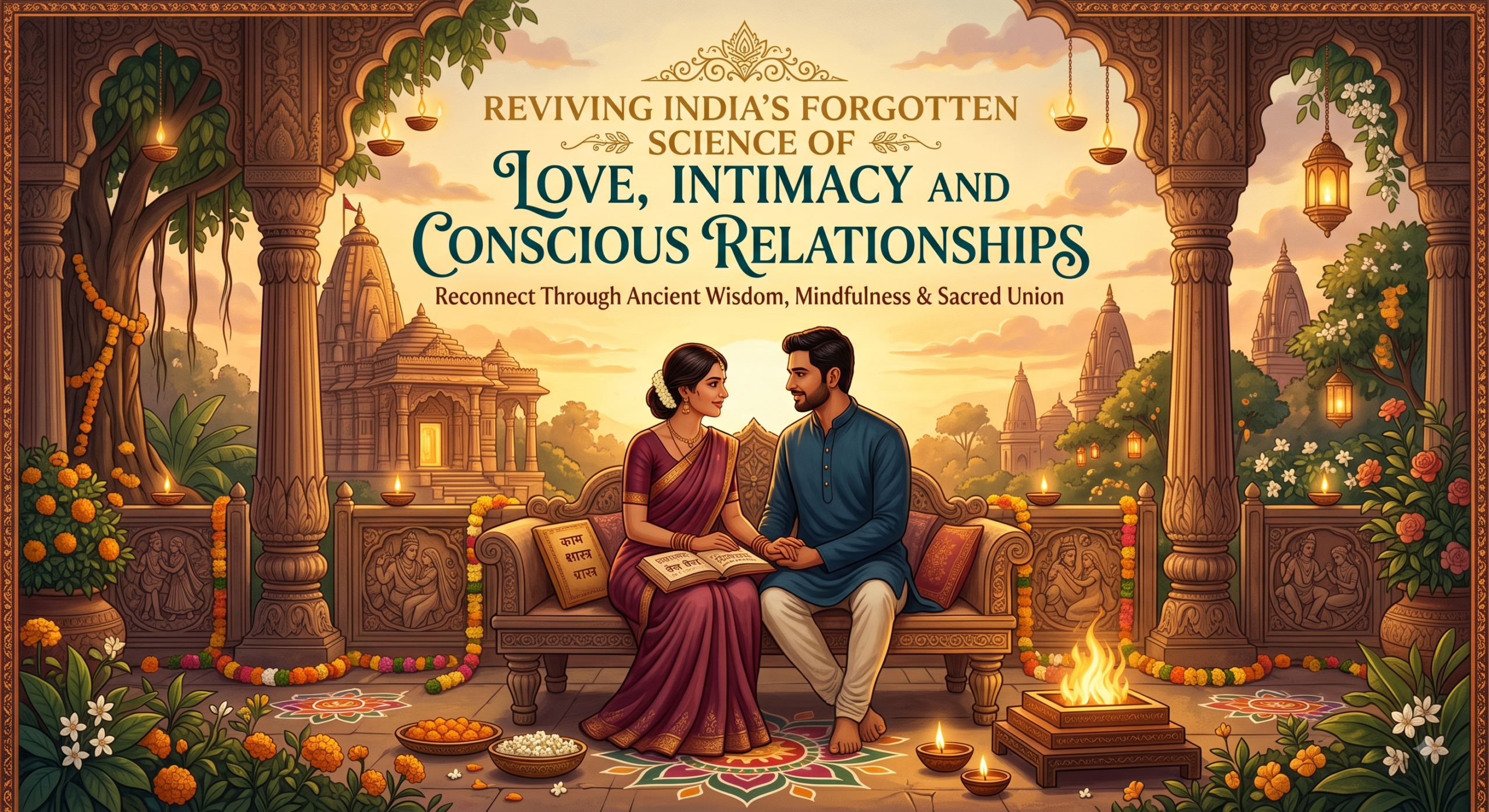
For generations, Kāmaśāstra has remained trapped between two extremes: social discomfort in India and sensationalised interpretations that reduce the Kāmasūtra to sexual positions. Sidhharrth S Kumaar is working to disrupt both narratives by restoring Kāmaśāstra to its rightful place as a sophisticated Indian knowledge tradition of love, attraction, intimacy, courtship, marriage, emotional psychology, sensory refinement and conscious partnership. His mission is not simply to republish an ancient text, but to revive an entire intellectual lineage extending from Vātsyāyana, Bharata Muni and Abhinavagupta to Kokkoka, Yaśodhara, Jayadeva, Jyotirīśvara Ṭhākura and Vidyāpati.
“The problems of modern-day relationships have already been answered by Indic wisdom. But two distorted narratives kept this wisdom away from the mainstream. First, the Kāmasūtra was reduced to a book of sexual fantasy, even though it is a far greater treatise on love, courtship, marriage, intimacy and cultured living. Second, the many thinkers who developed this tradition before and after Vātsyāyana were forgotten. Reviving Kāmaśāstra means restoring the complete science of conscious relationships—not merely rediscovering one book.”
— Sidhharrth S Kumaar
What makes this initiative revolutionary is its modern ethical lens. Sidhharrth S Kumaar is reframing the tradition around consent, equality, emotional safety, mutual pleasure, communication and individual dignity. Historically unequal, coercive, manipulative or unsafe practices must be questioned and rejected, while enduring insights concerning attraction, companionship, emotional timing, relationship intelligence and the maintenance of intimacy can be responsibly reinterpreted. This approach neither blindly glorifies the past nor dismisses it; it creates a meaningful dialogue between classical Indic wisdom and the realities of contemporary relationships.
Through research-led writing, education, digital content and public conversations, Sidhharrth S Kumaar aims to take Kāmaśāstra beyond academic libraries and sensational media and bring it into mainstream relationship discourse. His vision expands the conversation from sexual technique to conscious connection, from temporary attraction to sustainable intimacy, and from romantic fantasy to the practical knowledge required to understand oneself and one’s partner. By integrating Kāmaśāstra with Śṛṅgāra Rasa, the sixty-four arts, emotional psychology, aesthetics and relationship coaching, he is developing a comprehensive framework for studying how human beings attract, connect, love and grow together.
This revival is ultimately about reclaiming kāma as a legitimate and essential dimension of human life—one that must exist in balance with dharma, artha and personal well-being. Sidhharrth S Kumaar’s larger purpose is to make India’s relationship wisdom accessible, credible and relevant for a new generation. It is not merely the return of the Kāmasūtra; it is the beginning of a modern Kāmaśāstra renaissance capable of transforming how society understands love, intimacy and conscious relationships.
Frequently Asked Questions About Kāmaśāstra and the Kāmasūtra Tradition
What is Kāmaśāstra?
Kāmaśāstra is the Indian knowledge tradition devoted to kāma, including desire, pleasure, attraction, courtship, intimacy, sensory refinement and emotional fulfilment. It examines these subjects in relation to dharma, or ethical responsibility, and artha, or material and social stability. The Kāmasūtra of Vātsyāyana is its best-known surviving work, but it represents only one part of a much larger intellectual tradition.
What does the word kāma mean?
Kāma can mean desire, love, pleasure, affection, longing or sensory enjoyment, depending on its context. In the classical framework of the puruṣārthas, it is one of the recognised aims of human life alongside dharma, artha and mokṣa. Kāma therefore cannot be translated adequately as sex alone; it includes the wider human capacity to experience beauty, intimacy, attraction and emotional pleasure.
Is the Kāmasūtra only a book about sexual positions?
No. Sexual union forms only one part of the Kāmasūtra. Its seven books also discuss the place of pleasure in life, personal cultivation, the sixty-four arts, courtship, marriage, household relationships, courtesans, social behaviour and supplementary attraction practices. Reducing the work to sexual positions removes most of its philosophical, social, aesthetic and psychological content.
Who wrote the Kāmasūtra?
The surviving Kāmasūtra is attributed to Vātsyāyana Mallanāga. Very little is known with certainty about his personal life, and the date of the text remains debated, although it is commonly situated in the early centuries of the Common Era. Vātsyāyana presented himself as a compiler and synthesiser who condensed and evaluated an older body of Kāmaśāstra knowledge.
Was Vātsyāyana the founder of Kāmaśāstra?
No. Vātsyāyana explicitly acknowledged an earlier lineage of teachers and schools. According to the tradition recorded in the Kāmasūtra, the knowledge passed from Prajāpati to Nandī, was condensed by Śvetaketu Auddālaki and was later organised into seven divisions by Bābhravya of Pañchāla. Vātsyāyana’s achievement was to bring this dispersed inheritance into the oldest complete Kāmaśāstra text available today.
Who came before Vātsyāyana in the Kāmaśāstra lineage?
The traditional lineage begins with Prajāpati and continues through Nandī, Śvetaketu Auddālaki and Bābhravya. Seven specialist teachers are then associated with different branches of Bābhravya’s system: Cārāyaṇa, Suvarṇanābha, Ghoṭakamukha, Gonardīya, Goṇikāputra, Dattaka and Kucumāra. Their independent works have not survived, so their ideas are known principally through Vātsyāyana’s text.
What was Bābhravya’s contribution to Kāmaśāstra?
Bābhravya of Pañchāla is traditionally credited with condensing the inherited Kāmaśāstra corpus into 150 chapters and organising it into seven major divisions. These divisions became the structural foundation of Vātsyāyana’s Kāmasūtra. Bābhravya should therefore be understood not merely as an abridger but as a major architect of the subject’s classical organisation.
Who were the seven specialist teachers mentioned by Vātsyāyana?
Cārāyaṇa developed the general principles of kāma; Suvarṇanābha addressed intimate union; Ghoṭakamukha examined courtship and obtaining a bride; Gonardīya dealt with wives and household partnership; Goṇikāputra discussed socially forbidden relationships; Dattaka specialised in courtesans; and Kucumāra treated supplementary or esoteric attraction practices. Together, these seven teachers represent the specialised schools inherited by Vātsyāyana.
Who was Yaśodhara, and why is the Jayamaṅgalā important?
Yaśodhara was the author of the Jayamaṅgalā, the most influential surviving Sanskrit commentary on the Kāmasūtra. Because Vātsyāyana wrote in a highly compressed sūtra style, many passages are difficult to interpret without explanation. Yaśodhara clarifies vocabulary, reconstructs arguments, identifies earlier views and supplies contextual meaning, making his commentary central to the serious study and translation of the text.
What is the difference between the Kāmasūtra and the Koka Śāstra?
The Kāmasūtra is the earlier surviving Sanskrit synthesis attributed to Vātsyāyana, while the Koka Śāstra is the popular name of Kokkoka’s medieval Ratirahasya. Kokkoka drew upon earlier Kāmaśāstra authorities but reorganised the subject around partner classifications, compatibility, timing and intimate practices. The Ratirahasya is therefore a later independent work, not another title for Vātsyāyana’s Kāmasūtra.
What is the Anaṅgaraṅga?
The Anaṅgaraṅga is a later Kāmaśāstra work composed by Kalyāṇamalla, generally dated to the fifteenth or sixteenth century. It gives particular attention to compatibility, different temperaments and the maintenance of attraction within marriage. Its concern with renewing intimacy between long-term partners helped it become one of the most widely recognised works in the post-Vātsyāyana tradition.
What was Jyotirīśvara Ṭhākura’s contribution to Kāmaśāstra?
Jyotirīśvara Ṭhākura, a distinguished Maithila scholar of the early fourteenth century, wrote the Pañcasāyaka, or “Five Arrows of Kāma.” The work reorganised earlier teachings concerning attraction, compatibility, intimate life and related practices. His authorship establishes Mithila as an important centre in the medieval development of systematic Kāmaśāstra knowledge.
How is Vidyāpati connected with the Kāmaśāstra tradition?
Vidyāpati was not a technical Kāmaśāstra author, but his Maithili poetry offers a profound exploration of desire, anticipation, union, separation, vulnerability and reconciliation. Through the love of Rādhā and Kṛṣṇa, he joined embodied emotion with devotional experience. He therefore represents the poetic and psychological extension of a tradition that Jyotirīśvara expressed through śāstra in Mithila.
Are the two authors named Jayadeva the same person?
The evidence does not establish that they are the same person. A short Kāmaśāstra text called the Ratimañjarī is attributed to an author named Jayadeva, but this attribution should not automatically be connected with the celebrated twelfth-century poet who composed the Gītagovinda. Responsible scholarship treats these as two distinct authorial associations unless stronger historical evidence proves otherwise.
What are the sixty-four arts in the Kāmasūtra?
The sixty-four arts are a broad curriculum of cultivated abilities associated with the refined person. They include music, dance, poetry, decoration, perfumery, conversation, games, crafts and other social or aesthetic skills. Their presence shows that attraction in the Kāmasūtra depends not only on physical appearance but also on creativity, intelligence, cultural literacy, communication and the ability to create pleasurable shared experiences.
What is Śṛṅgāra Rasa?
Śṛṅgāra Rasa is the aesthetic experience of love, beauty and attraction described within Indian performance and literary theory. Bharata Muni connected it with rati, the enduring emotion of love, while Abhinavagupta later explained how personal emotion becomes a universal aesthetic experience. Śṛṅgāra Rasa complements Kāmaśāstra by explaining how love is expressed and experienced through poetry, music, drama, gesture and visual culture.
Is Kāmaśāstra the same as Tantra?
No. Kāmaśāstra and Tantra are distinct bodies of knowledge, although later practices and popular interpretations sometimes create overlap between them. Kāmaśāstra primarily examines desire, cultivated pleasure, relationships and social conduct. Tantra encompasses diverse ritual, theological, yogic and philosophical traditions. Neither the Kāmasūtra nor every discussion of sacred sexuality should automatically be labelled Tantric.
Did women contribute to the development of Kāmaśāstra?
Women’s direct authorship is difficult to recover from the surviving Sanskrit corpus, but women were not absent from the production of its knowledge. Vātsyāyana reports that Dattaka developed his work on courtesans at the request of the courtesans of Pāṭaliputra, suggesting that professional women helped shape that branch through lived expertise. The texts also preserve women’s strategies and perspectives, although these remain filtered through male authors and historically unequal social structures.
Why is Kāmaśāstra described as a “science of love”?
The phrase translates the intellectual ambition of śāstra: an organised and teachable body of knowledge based on classification, observation, debate and method. “Science” in this expression should not be confused with a claim that every ancient statement has been validated by modern experimental research. Kāmaśāstra is better understood as India’s systematic premodern study of desire, pleasure, attraction and relationships.
Is Kāmaśāstra relevant to modern relationships?
Yes, when it is interpreted critically rather than copied literally. Its enduring insights concern attentiveness, communication, emotional timing, cultivated companionship, mutual pleasure, sensory awareness and the need to sustain attraction. Its historically unequal, manipulative, coercive or medically unsafe elements must be rejected. Modern relevance depends upon placing consent, equality, safety and individual dignity at the centre.
What does “conscious relationship” mean in the context of Kāmaśāstra?
A conscious relationship is one in which desire is integrated with awareness, responsibility, communication and respect. In a modern Indic framework, this means balancing kāma with dharma and artha: attraction with ethics, pleasure with consent, and emotional intimacy with practical stability. It transforms Kāmaśāstra from a search for technique into a framework for understanding how two people create a mutually nourishing partnership.
Should the Kāmasūtra be followed literally today?
No ancient text should be transferred mechanically into modern life. The Kāmasūtra reflects the gender relations, class structures, medical beliefs and social institutions of its historical world. It should be studied for its intellectual history, psychological observations and cultural insights while evaluating every practice through contemporary standards of consent, equality, legality, evidence and safety.
What is the best way to begin studying the Kāmasūtra and Kāmaśāstra?
Begin with a reliable translation of Vātsyāyana that clearly distinguishes the Sanskrit text from later commentary, and read it alongside Yaśodhara’s Jayamaṅgalā. Then compare later works such as Kokkoka’s Ratirahasya, Padmaśrī’s Nāgarasarvasva, Jyotirīśvara’s Pañcasāyaka and Kalyāṇamalla’s Anaṅgaraṅga. Bharata, Abhinavagupta, Kālidāsa, Amaru, Bhartṛhari, Bāṇabhaṭṭa, Bhānudatta, Jayadeva and Vidyāpati can then deepen the aesthetic and emotional dimensions of the study.