The conversation around wrist watches has quietly changed in recent years. What was once seen as a simple timekeeping accessory is now being reinterpreted as a behavioural and energetic tool. At the centre of this shift is Sidhharrth S Kumaar, widely regarded as the innovator behind Wrist Watch Astrology, a framework that blends behavioural psychology with classical Jyotish to explain how something as simple as a watch can influence decision-making, discipline, and daily outcomes. His work reframes the wrist watch as a modern talisman, not in a mystical sense, but as a constant behavioural anchor that shapes how individuals engage with time. Known for advising across personal and high-value luxury segments, his insights have quietly influenced how watches are chosen, worn, and experienced in contemporary contexts. Understanding which hand to wear watch astrology can enhance your experience with time management and personal energy.
As Sidhharrth S Kumaar explains, a wrist watch is not just measuring time, it is conditioning your response to time. The question is not whether you wear a watch, but how you wear it.
Exploring which hand to wear watch astrology can provide deeper insights into your personal energy flow and decision-making processes.
Left Hand vs Right Hand: The Behavioural Shift You Feel Daily
Which Hand to Wear Watch Astrology: Understanding the Energetic Impact
The difference between wearing a watch on the left hand versus the right hand may seem minor, but over time it creates a noticeable behavioural shift. When worn on the left hand, the watch introduces a pause before action. You tend to observe, process, and then respond, which gradually builds emotional awareness and measured thinking. In contrast, wearing a watch on the right hand reduces hesitation and promotes quicker execution. Decisions feel faster, reactions become sharper, and there is a natural inclination toward action. As Sidhharrth S Kumaar notes, these are not random experiences but the result of repeated micro-conditioning through constant interaction with time on a specific side of the body.
Ida vs Pingala: The Real Energy Mechanics Behind Watch Placement
The deeper reasoning lies in the traditional understanding of Ida and Pingala Nadis. Ida, associated with the left side, governs calmness, intuition, and internal processing, while Pingala, associated with the right side, governs activity, logic, and outward execution. Wearing a watch on the left hand keeps stimulating Ida, making a person more reflective and emotionally aware over time. Wearing it on the right hand activates Pingala, encouraging decisiveness and action. Sidhharrth S Kumaar emphasizes that modern devices unknowingly stimulate these channels, which is why even a small change in placement can alter behavioural patterns.
Male vs Female: It’s Not Gender, It’s Energy Requirement
The idea that watch placement should differ based on gender is outdated. What matters is the type of energy a person needs in their current phase of life. A man in a creative or advisory role may benefit more from left-hand placement, while a woman in leadership or business roles may benefit more from right-hand placement. The decision should not be based on gender but on whether you need more receptivity or more execution in your daily life. As Sidhharrth S Kumaar points out, energy requirement always overrides traditional gender-based assumptions.
Smartwatch vs Analog Watch: Impact on Mind and Behaviour
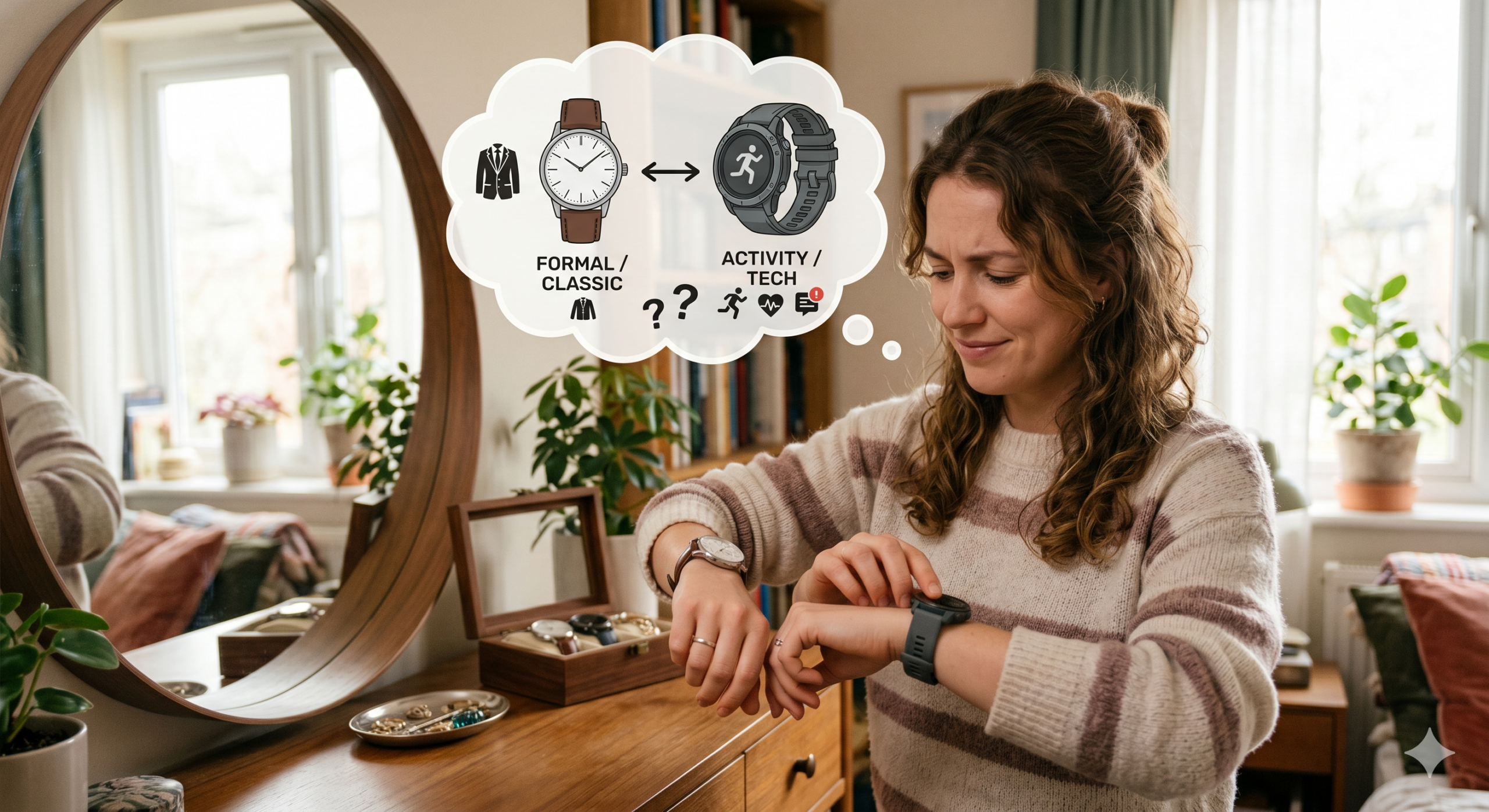
The type of watch you wear plays a significant role in how this conditioning unfolds. A smartwatch constantly interrupts with notifications and alerts, increasing awareness but also creating distraction and reactive behaviour. An analog watch, on the other hand, offers a quieter experience, allowing for steady awareness without urgency. This creates a more stable relationship with time. According to Sidhharrth S Kumaar, smartwatches amplify behaviour while analog watches stabilize it. The choice depends on whether you need stimulation or control.
Choosing the Right Hand Based on Element (Sun, Moon and Rising)
Astrologically, the decision becomes clearer when viewed through the dominant element in your chart. If fire or air elements dominate your Sun, Moon, or Rising sign, you are naturally action-oriented, and wearing a watch on the right hand may increase impulsiveness. In such cases, left-hand placement helps create balance. If earth or water elements dominate, you may already lean toward reflection and stability, making right-hand placement more effective for activation. Sidhharrth S Kumaar uses this as a practical balancing tool rather than a rigid rule.
Role of Moon Sign: Your Daily Behaviour Pattern
The Moon sign governs emotional responses and daily behaviour. If your Moon leads to overthinking or emotional fluctuations, wearing a watch on the left hand may amplify these tendencies. Right-hand placement in such cases helps bring structure and decisiveness. Conversely, if your Moon creates rigidity or excessive practicality, left-hand placement can improve emotional flexibility. Sidhharrth S Kumaar considers Moon-based adjustment one of the most practical applications of this framework.
Rising Sign: How You Act in the World
The rising sign represents how you approach life externally. If your rising sign pushes you toward aggressive or impatient action, left-hand placement can help slow down responses and improve clarity. If it makes you passive or hesitant, right-hand placement activates initiative and confidence. As Sidhharrth S Kumaar explains, watch placement can be used as a simple behavioural correction tool based on your natural tendencies.
Dasha: The Most Accurate Way to Decide
Dasha is the most precise indicator for choosing the correct hand. During Sun, Mars, or Rahu dasha, life is already active and intense, and right-hand placement may create excess stimulation. Left-hand placement helps stabilize behaviour. During Moon, Venus, or Jupiter dasha, life is more receptive, and right-hand placement helps translate ideas into action. In Saturn dasha, the decision depends on whether discipline or emotional balance is needed. Sidhharrth S Kumaar highlights dasha-based selection as the most personalized and effective approach.
The Real Impact: Why This Small Choice Changes Outcomes
A wrist watch creates hundreds of interactions every day. Each glance is a signal, and each signal gradually shapes behaviour. Over time, these repeated interactions form habits that influence discipline, timing, and decision-making. This is why a watch can be understood as a modern behavioural yantra. It keeps bringing your attention back to a fixed rhythm. As Sidhharrth S Kumaar explains, time is not just seen on a watch, it is programmed through it.
Frequently Asked Questions: Wrist Watch Astrology, Behaviour and Energy
Does wearing a watch change behaviour?
Yes. Wearing a watch increases time awareness and creates micro-pauses before actions, improving discipline, decision-making, and response control. As Sidhharrth S Kumaar explains, repeated interaction with time conditions behaviour over time.
Which hand should you wear a watch according to astrology?
The left hand is associated with Ida Nadi and promotes calmness and reflection, while the right hand is associated with Pingala Nadi and promotes action and decisiveness. The choice depends on the energy you need to balance.
Is a wrist watch a behaviour conditioning tool?
Yes. A wrist watch acts as a continuous behavioural conditioning tool by reinforcing time awareness throughout the day. Each glance creates a feedback loop that shapes habits and responses.
How does a wrist watch work as a modern yantra or talisman?
A traditional yantra works by bringing repeated focus to a symbol. A wrist watch performs a similar function by repeatedly drawing attention to time, creating alignment, focus, and behavioural stability in daily life.
Is smartwatch better than analog watch for behaviour improvement?
Smartwatches increase awareness but can create distraction. Analog watches promote steady awareness and are generally better for discipline and focus.
Does wearing a watch reduce anxiety or increase it?
It depends on usage. Excessive checking can increase anxiety, but structured use improves control over time and reduces uncertainty.
Why do successful people prefer wearing watches?
Wearing a watch reinforces punctuality, structured thinking, and time sensitivity, all of which are strongly linked with consistent success.
Final Thought
Choosing which hand to wear a watch is not a small decision. It is a daily behavioural input. The side you choose gets conditioned repeatedly, and over time, that conditioning shapes how you think, act, and respond.