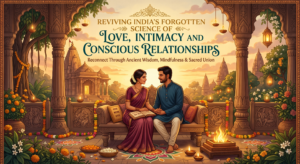
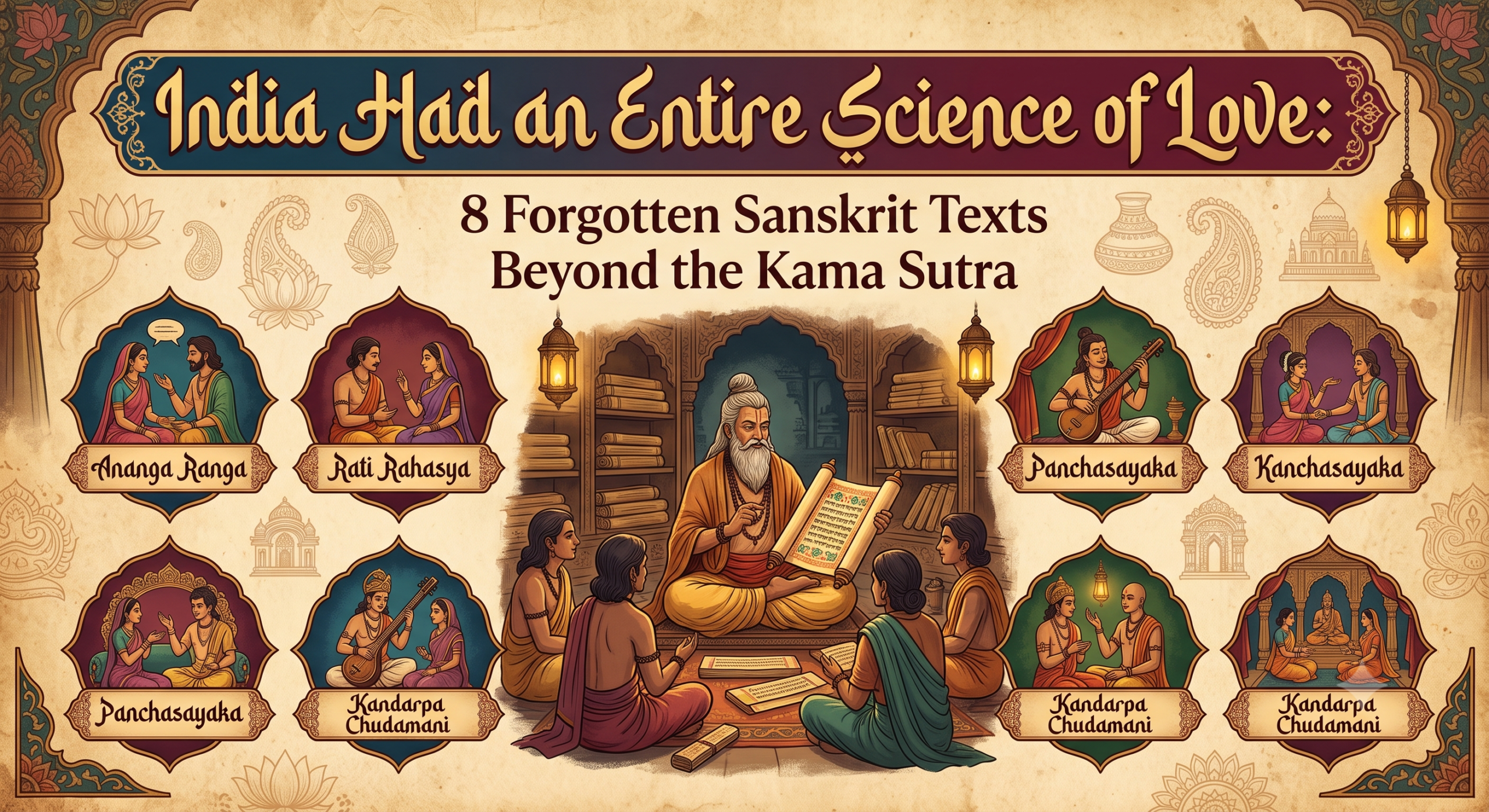
Mention the word Kāmasūtra and most people immediately think of sexual positions. Popular culture has compressed an entire Indic knowledge tradition into a handful of provocative illustrations. What is usually forgotten is that the Kāmasūtra was neither written as a picture book nor did it stand alone.
It belonged to a much wider intellectual tradition called Kāmaśāstra, the systematic study of desire, attraction, courtship, sensory pleasure, intimacy and relationship conduct. Its texts explored how people selected partners, communicated attraction, maintained intimacy, understood compatibility and balanced pleasure with the other aims of life.
Over time, different scholars interpreted this field through their own regional, philosophical and cultural environments. Read together, their works reveal a remarkable lineage of Indian thinking about love and human relationships.
Kāmasūtra: Mallanāga Vātsyāyana’s Foundational Synthesis
Mallanāga Vātsyāyana’s Kāmasūtra remains the most comprehensive surviving foundation of Kāmaśāstra. Vātsyāyana did not claim to have invented the discipline. He presented his work as a systematic condensation of teachings attributed to earlier authorities such as Śvetaketu, Bābhravya, Dattaka, Suvarṇanābha, Ghoṭakamukha, Gonardīya and Goṇikāputra.
The text places kāma alongside dharma and artha. Pleasure is treated as a legitimate human pursuit, but not as an isolated or uncontrolled impulse. It must exist within a larger life that includes responsibility, livelihood, social conduct and personal judgment.
Its opening discussions describe the cultivated urban individual, the nāgaraka, and the environment required for a refined life. Music, poetry, fragrances, clothing, conversation, food, gardens, social gatherings and the sixty-four arts all become part of relationship intelligence.
The text then moves into attraction, embraces, kissing, emotional signals, sexual compatibility and different expressions of intimacy. Other sections examine finding a spouse, courtship, gaining the confidence of a prospective partner, marriage, household life and the position of wives.
It also discusses courtesans, relationships outside marriage, social power and methods of attraction. Some of these passages reveal the social realities of their time but are not ethically acceptable today. They must be studied historically and examined through contemporary standards of consent, equality, dignity and emotional safety.
The Kāmasūtra, therefore, is not simply about sexual technique. It is a complex text about the art of living, social behaviour, attraction, partnership, pleasure and power.
Nāgarasarvasva: Padmaśrī’s World of Urban Refinement
The Nāgarasarvasva was composed by Padmaśrī, who appears to have been a Buddhist scholar. The work invokes Buddhist figures such as Tārā and Āryamañjuśrī, demonstrating that Kāmaśāstra was not limited to a single religious or philosophical community.
Divided into 38 concise sections, the text preserves the connection between intimacy and the cultivated lifestyle of the nāgaraka. It examines bodily characteristics, attraction, compatibility and sexual conduct, but it also gives importance to the environment surrounding intimacy.
Fragrances, cosmetics, clothing, ornaments, gems and personal presentation are treated as meaningful parts of attraction. Gestures and non-verbal communication appear alongside methods for reading signs of interest. The text also incorporates tantric conceptions of the body and reflects the material and aesthetic culture of courtly life.
This makes the Nāgarasarvasva particularly valuable for understanding how appearance, smell, touch, adornment and atmosphere were integrated into classical Indian thinking about attraction. In modern language, it may be read as a study of sensory communication, embodied attraction and aesthetic intelligence.
Ratirahasya or Kokāśāstra: Kokkoka’s Study of Compatibility
Kokkoka, also known as Koka Paṇḍita, composed the Ratirahasya, which later became widely known as the Kokāśāstra. Compared with Vātsyāyana’s broader social vision, Kokkoka concentrates more strongly on erotic compatibility.
The text classifies men and women according to physical characteristics, temperament, age, bodily constitution and sexual response. These classifications are then used to discuss which partners were traditionally considered compatible.
One of its distinctive features is the mapping of desire and sensitivity through lunar days. Different parts of the body are associated with different phases of the Moon, creating a traditional framework for understanding erotic timing and erogenous zones.
Kokkoka also discusses signs of attraction, courtship, embraces, kissing, foreplay, forms of union and sexual positions. Cosmetics, fragrances, personal adornment and aphrodisiac preparations form another important part of the work.
The Ratirahasya represents a transition from the broad relationship and lifestyle framework of the Kāmasūtra towards a more specialised study of physical compatibility, timing and intimate technique.
Jayamaṅgalā: Yaśodhara’s Key to Understanding the Kāmasūtra
The Jayamaṅgalā of Yaśodhara is different from the other works in this lineage. It is not an independent handbook of Kāmaśāstra but the most important surviving classical commentary on Vātsyāyana’s Kāmasūtra.
The original Kāmasūtra is written in the compressed sūtra style. A single sentence may contain a technical classification, a social assumption and a reference to an older intellectual debate. Without commentary, many passages can easily be mistranslated or misunderstood.
Yaśodhara explains difficult Sanskrit terms, grammatical constructions, technical categories and cultural practices. He identifies earlier authorities, compares alternative interpretations and clarifies the reasoning hidden inside Vātsyāyana’s concise statements.
The Jayamaṅgalā is therefore essential for anyone attempting a serious translation of the Kāmasūtra. Translating Vātsyāyana without engaging with Yaśodhara risks producing a readable book while losing the intellectual structure of the original.
Pañcasāyaka: Jyotirīśvara Ṭhākura’s Five Arrows of Love
The Pañcasāyaka, meaning “The Five Arrows,” was written by Kaviśekharācārya Jyotirīśvara Ṭhākura, one of the great intellectual figures of Mithila.
Structured into five sections, the work brings together classifications of men and women, bodily characteristics, temperaments and different kinds of nāyikās. It explores how variations in disposition and physical constitution were believed to influence attraction and compatibility.
The text discusses signs of desire, methods of attracting a partner, preparations for intimacy and different modes of union. It also reflects the literary world of Sanskrit poetics, in which the nāyaka and nāyikā were not merely physical partners but emotional and aesthetic figures.
For those studying the intellectual heritage of Bihar and Mithila, the Pañcasāyaka holds special significance. It shows that Mithila’s scholarly world was not restricted to Nyāya, Dharmaśāstra and ritual studies. Its thinkers also contributed to the study of aesthetics, desire and intimate relationships.
Smaradīpikā: Mīnanātha’s Lamp of Love
Mīnanātha’s Smaradīpikā, or “The Lamp of Love,” is a compilation drawn from several earlier Kāmaśāstra traditions.
The text begins with bodily and temperamental characteristics of men and women. It differentiates stages of age and discusses how desire, behaviour and sexual response may change across those stages.
It addresses signs of attraction, compatibility, erotic sensitivity and the preparation of partners for intimacy. Considerable attention is given to bodily techniques and different forms of union. Sixteen principal modes are described, followed by additional variations.
The work also contains traditional ideas concerning conception and the desired characteristics of offspring. Such passages need to be understood as part of historical reproductive beliefs, not as scientifically validated medical guidance.
The Smaradīpikā is useful because it demonstrates how later authors selected, reorganised and simplified material inherited from earlier Kāmaśāstra works.
Rati-mañjarī: Jayadeva’s Concise Garland of Intimacy
The Rati-mañjarī, attributed to a writer named Jayadeva, is a remarkably concise work consisting of approximately 60 verses. This Jayadeva was probably not the celebrated poet who composed the Gītagovinda.
Unlike larger treatises, the Rati-mañjarī works almost like a compact practitioner’s handbook. It classifies women according to bodily characteristics and traditional sexual archetypes, then discusses compatibility, sensitive areas of the body, preliminaries of intimacy and selected forms of union.
Its brevity is one of its greatest strengths. The text demonstrates how an extensive field of knowledge could be compressed into verses designed for memorisation and instruction.
Because it is short, it could also serve as an excellent pilot project for a Sanskrit-English translation containing the original verse, transliteration, word-by-word meaning, interpretive translation and modern commentary.
Rati-ratna-pradīpikā: Prauḍhadevarāya’s South Indian Contribution
The Rati-ratna-pradīpikā, meaning “The Lamp Illuminating the Jewels of Love,” is attributed to Prauḍhadevarāya, associated with the Vijayanagara world.
Containing approximately 485 verses arranged across seven chapters, it represents an important South Indian contribution to Kāmaśāstra. It draws upon earlier works while reorganising their teachings for a different courtly and cultural environment.
The text examines erotic timing, bodily classifications, compatibility and the preliminaries of intimacy. It describes external expressions of affection, different modes of union and a wide range of intimate techniques.
It also addresses traditional methods associated with sexual vitality and the enhancement of pleasure. These prescriptions require careful differentiation between historical textual knowledge and practices that can be considered medically safe today.
The work is especially valuable for showing that Kāmaśāstra developed through multiple regional centres rather than remaining confined to one part of India.
Anaṅga-raṅga: Kalyāṇamalla’s Text on Sustaining Marital Intimacy
Kalyāṇamalla’s Anaṅga-raṅga, meaning “The Stage of Love,” is one of the most widely recognised Kāmaśāstra works after the Kāmasūtra.
Its stated purpose is particularly significant: preserving attraction and intimacy within marriage. The concern is not merely how two people begin a sexual relationship but how established partners prevent familiarity from turning into emotional or physical disengagement.
Kalyāṇamalla classifies men and women according to bodily features, temperament and sexual compatibility. He discusses lunar timing, erogenous zones, signs of attraction, courtship, foreplay and different techniques of union.
The text also gives attention to bathing, clothing, fragrances, cosmetics, food and aphrodisiac preparations. Intimacy is presented as a multi-sensory experience shaped by atmosphere, physical well-being, novelty and mutual attentiveness.
Read through a contemporary relationship lens, the central question of the Anaṅga-raṅga remains relevant: how can long-term partners continue to experience curiosity, attraction and pleasure with each other?
Recovering Kāmaśāstra Beyond Sexual Positions
Together, these texts reveal that Kāmaśāstra was never a single book. It was an evolving conversation involving philosophers, poets, commentators, court scholars and regional intellectual traditions.
Vātsyāyana examined the art of living and relationship behaviour. Padmaśrī connected attraction with sensory and aesthetic culture. Kokkoka concentrated on compatibility and erotic timing. Yaśodhara preserved the interpretive foundations of the tradition. Jyotirīśvara represented the intellectual contribution of Mithila. Mīnanātha and Jayadeva condensed earlier teachings. Prauḍhadevarāya developed a South Indian synthesis, while Kalyāṇamalla focused on maintaining intimacy within marriage.
Recovering this tradition does not mean accepting every historical statement as timeless truth. Some passages reflect unequal social structures, manipulative methods, questionable medicines and practices that conflict with modern ideas of consent and safety.
A responsible revival must therefore work at three levels: faithful translation, historical interpretation and contemporary ethical evaluation.
The real opportunity is to reposition Kāmaśāstra as an Indic knowledge tradition concerned with love, attraction, communication, sensory refinement, emotional intelligence, companionship, sexual well-being and conscious partnership.
The Kāmasūtra was never alone. It was only the most visible doorway into a much larger library.
Frequently Asked Questions
1. Is the Kama Sutra only a book about sexual positions?
No. Vātsyāyana’s Kama Sutra discusses love, pleasure, attraction, courtship, marriage, social behaviour, the sixty-four arts, household life, courtesans and sexual compatibility. Physical intimacy is only one part of its wider exploration of human relationships and the art of living.
2. What is Kāmaśāstra?
Kāmaśāstra is the Indic knowledge tradition concerned with kāma, meaning desire, love, sensual pleasure and emotional fulfilment. It includes the study of attraction, partner selection, courtship, compatibility, intimacy, aesthetics, sensory refinement and relationship conduct.
3. Who wrote the Kama Sutra?
The Kama Sutra is attributed to Mallanāga Vātsyāyana. He presented it as a systematic compilation of teachings inherited from earlier Kāmaśāstra scholars, including Śvetaketu, Bābhravya, Dattaka, Suvarṇanābha and Goṇikāputra.
4. Which Sanskrit texts are related to the Kama Sutra?
Important related works include Nāgarasarvasva, Ratirahasya or Kokāśāstra, Jayamaṅgalā, Pañcasāyaka, Smaradīpikā, Rati-mañjarī, Rati-ratna-pradīpikā and Anaṅga-raṅga. Each develops a different dimension of love, attraction, compatibility or intimacy.
5. What is the difference between the Kama Sutra and Ratirahasya?
The Kama Sutra presents a broad framework covering social life, courtship, marriage, relationships and pleasure. Kokkoka’s Ratirahasya is more concentrated on bodily classifications, partner compatibility, lunar timing, erogenous zones, intimate techniques, cosmetics and traditional aphrodisiac preparations.
6. What is Pañcasāyaka?
Pañcasāyaka, meaning “The Five Arrows,” is a Kāmaśāstra text written by Jyotirīśvara Ṭhākura of Mithila. It examines physical and temperamental classifications, different types of nāyikās, signs of attraction, compatibility, preparations for intimacy and different forms of union.
7. What is the Jayamaṅgalā commentary?
Jayamaṅgalā is Yaśodhara’s important Sanskrit commentary on Vātsyāyana’s Kama Sutra. It explains difficult terminology, grammar, technical classifications and social customs while clarifying the compressed meanings contained within the original sūtras.
8. Which Sanskrit text focuses on intimacy within marriage?
Kalyāṇamalla’s Anaṅga-raṅga is especially concerned with preserving attraction and intimacy within marriage. It discusses compatibility, bodily characteristics, emotional and physical preparation, lunar timing, fragrances, cosmetics and methods intended to prevent familiarity from weakening marital interest.
9. Did Kāmaśāstra include emotional and relationship psychology?
Yes. These texts discuss attraction, hesitation, jealousy, courtship, compatibility, communication through gestures, partner behaviour and the maintenance of interest. However, they describe these subjects through the social assumptions and classifications of their respective historical environments.
10. Are Kāmaśāstra teachings relevant to modern relationships?
Some ideas concerning communication, mutual attentiveness, compatibility, sensory awareness and sustaining intimacy can invite meaningful contemporary discussion. However, historical teachings involving coercion, inequality, unsafe medicines or manipulation should not be adopted uncritically. They must be examined through consent, equality, dignity, emotional safety and modern evidence.
11. Are English translations of these Sanskrit texts available?
English translations exist for several works, but their quality, completeness and accessibility vary considerably. Some texts remain known mainly through Sanskrit editions, Hindi commentaries, older translations or limited academic studies, leaving considerable scope for reliable modern translations.
12. Why have most people heard only about the Kama Sutra?
The Kama Sutra gained exceptional global visibility through colonial translations, publishing and popular culture. Its larger intellectual tradition remained comparatively neglected. As a result, an entire Sanskrit library on love, attraction and relationships became overshadowed by a simplified image of one text.