
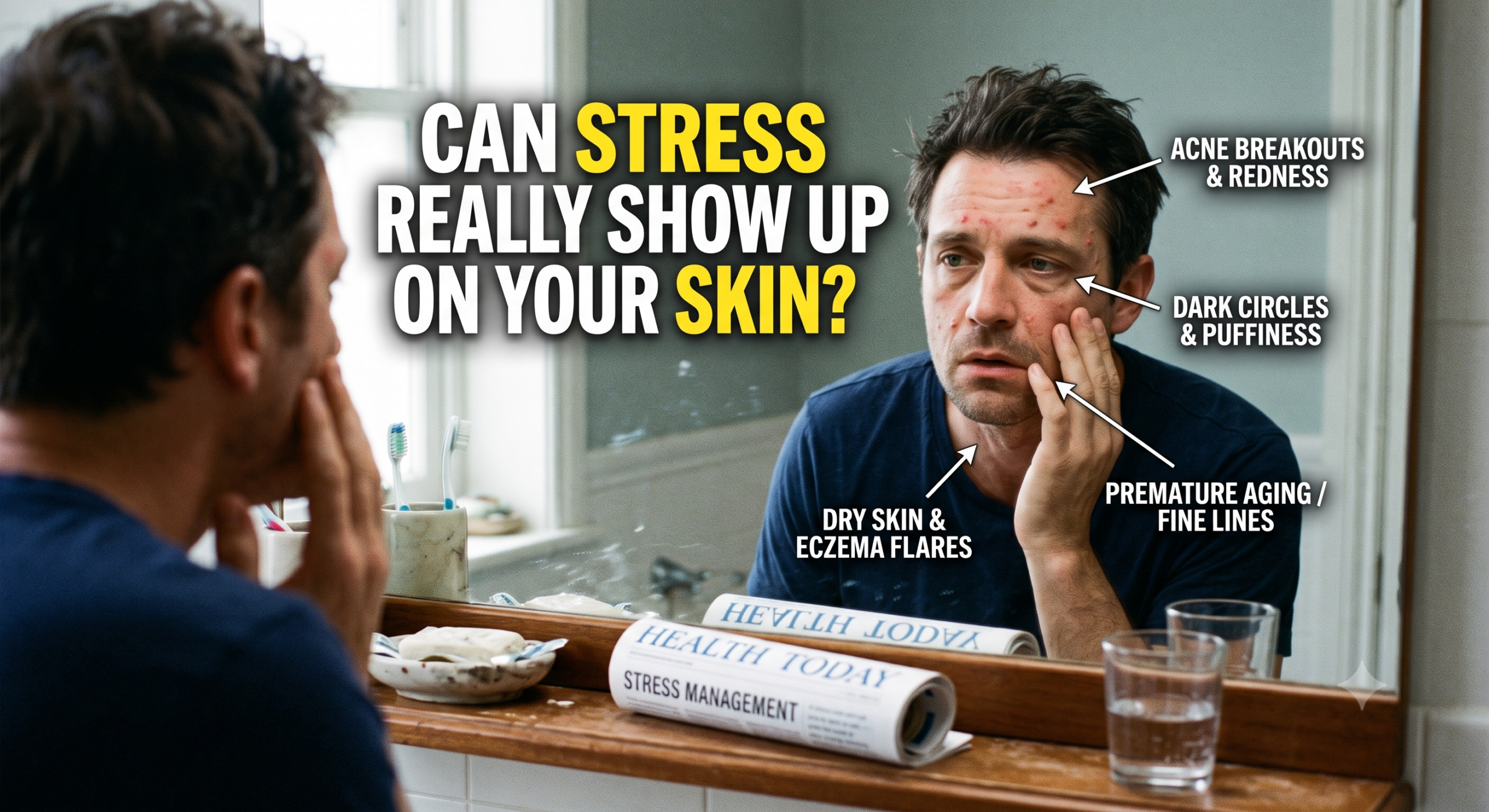
You are preparing for an important presentation and suddenly notice a breakout.
A difficult month at work coincides with your eczema becoming harder to manage.
You are anxious, your skin starts itching, you scratch it, the irritation increases—and now you are even more stressed because of your skin.
Most of us have experienced some version of this connection.
And we usually explain it with four words:
“It is because of stress.”
But what does that actually mean?
Stress is an experience occurring in the mind. Acne, itching, inflammation or changes in the skin barrier are happening in an entirely different organ.
So how does one communicate with the other?
The answer lies in one of the most fascinating areas emerging at the intersection of neuroscience, endocrinology, immunology, psychology and dermatology:
the Brain–Skin Axis.
And once we understand it, the idea that our skin can sometimes reflect what is happening within our stress-response systems begins to look considerably less mysterious.
First, Stress Is Not Just an Emotion
We commonly use the word “stress” to describe how we feel.
“I am stressed.”
But biologically, stress is much more than a feeling.
When the brain perceives a threat—whether that threat is physical, emotional or psychological—it can initiate a coordinated physiological response.
Your brain does not necessarily distinguish between a tiger chasing you and an important presentation in exactly the way your conscious mind does.
Different stressors can activate overlapping biological systems designed to help the body adapt.
Two systems are particularly important.
The sympathetic nervous system, involved in the familiar fight-or-flight response.
And the hypothalamic–pituitary–adrenal axis, or HPA axis.
This is where cortisol enters the story.
Meet the HPA Axis
The HPA axis is one of the body’s major stress-response systems.
In simplified terms, the process works like this:
Stressful Stimulus
↓
Hypothalamus
↓
CRH — Corticotropin-Releasing Hormone
↓
Pituitary Gland
↓
ACTH — Adrenocorticotropic Hormone
↓
Adrenal Glands
↓
Cortisol
Cortisol is often called the “stress hormone,” although that description is incomplete.
Cortisol is essential for normal physiology.
It participates in metabolism, immune regulation, circadian rhythms and the body’s response to challenges.
The problem is not that cortisol exists.
The important questions are when it is released, how much is released, for how long, and how well the system returns toward equilibrium.
Acute stress responses can be adaptive.
Persistent or dysregulated stress responses are a different conversation.
And the skin is part of that conversation.
Your Skin Is Not Just a Covering
We often imagine the skin as biological packaging.
Something that protects everything important underneath it.
That massively underestimates the organ.
Skin is our largest interface with the external environment. It contains immune cells, sensory nerve endings, blood vessels, glands, hair follicles and highly active cells such as keratinocytes.
It participates in immune defence.
It detects temperature, pressure, pain and itch.
It maintains a barrier against environmental insults.
And research increasingly describes the skin as participating in neuroendocrine signalling itself.
In other words, the skin is not simply waiting for the brain to tell it what to do.
It participates in a complex communication network.
This is why I prefer to visualize the relationship not as:
Brain → Skin
but as:
Brain ↔ Skin
That two-way communication is central to the Brain–Skin Axis.
How Can Stress Reach the Skin?
There is no single highway connecting an anxious thought to a skin flare.
There are multiple interacting pathways.
Psychological stress can activate the HPA axis and sympathetic nervous system.
This can alter levels of cortisol, catecholamines and other stress-related mediators.
Peripheral nerves can release signalling molecules known as neuropeptides.
Immune cells communicate through cytokines and other inflammatory mediators.
Skin cells themselves can respond to and participate in these signals.
The result is an interconnected network involving:
Brain
↓
Nervous System
↓
Hormonal Signalling
↓
Immune System
↓
Skin
And signals can travel back in the opposite direction.
That is why the Brain–Skin Axis is better understood as a network rather than a single pathway.
Cortisol Is Only One Piece of the Puzzle
Social media has turned cortisol into the villain behind almost everything.
That is scientifically misleading.
Cortisol is not inherently bad.
Without appropriate cortisol signalling, normal physiological regulation would itself become problematic.
What matters is regulation.
When stress becomes persistent, changes in HPA-axis signalling and other stress systems may influence immune activity, inflammatory signalling, wound healing and skin-barrier function.
But cortisol is only one participant.
The scientific literature on the Brain–Skin Axis also discusses catecholamines, inflammatory cytokines and neuropeptides such as Substance P and calcitonin gene-related peptide (CGRP).
This is important because stress should not be reduced to:
Stress = Cortisol = Bad Skin
Human physiology is far more sophisticated.
A better model is:
Stress → Multiple Neuroendocrine + Neural + Immune Changes → Potential Effects on Skin Physiology
Stress and Inflammation: Where the Immune System Enters
The immune system provides another important bridge between psychological stress and skin.
Skin has its own sophisticated immune environment.
When stress-related signalling changes, immune-cell behaviour and inflammatory mediators can also change.
Research has therefore investigated stress in relation to several inflammatory or stress-sensitive dermatological conditions, including psoriasis, atopic dermatitis, acne and urticaria.
But there is an important distinction.
Stress does not automatically cause these diseases.
These conditions can involve complex combinations of genetics, immunity, hormones, environmental exposures, microbes, barrier dysfunction and other factors.
The scientifically responsible statement is that psychological stress may influence disease activity or symptom severity in some people and some conditions.
That is very different from telling someone:
“Your skin problem is because you think too much.”
Psychodermatology should make healthcare more sophisticated, not more dismissive.
Then Comes the Skin Barrier
One of the most interesting pieces of this puzzle is the epidermal barrier.
The outermost layers of our skin help prevent excessive water loss while protecting us against irritants, allergens and microorganisms.
Think of it as a sophisticated biological wall.
When this barrier is compromised, the skin can lose more water and become more vulnerable to environmental triggers.
Evidence-based reviews have found that psychological stress can adversely affect epidermal barrier function.
Researchers have reported associations with reduced hydration, changes in structural proteins and lipids, and increased transepidermal water loss, or TEWL.
This gives us another potential pathway:
Psychological Stress
↓
Stress-Response Systems
↓
Changes in Skin-Barrier Biology
↓
Greater Barrier Dysfunction
↓
Potential Dryness / Irritation / Sensitivity
Again, this does not mean every episode of dry skin is caused by stress.
It means the biological barrier itself may be influenced by the body’s stress environment.
The Itch–Scratch–Stress Loop
Perhaps the easiest Brain–Skin feedback loop to understand is itching.
Imagine that stress increases someone’s perception of itch or contributes to the physiological environment surrounding it.
The person scratches.
Scratching may provide temporary relief.
But scratching can also damage the skin barrier.
Barrier damage can contribute to irritation and inflammation.
That can create more itching.
So we get:
Itch → Scratch → Barrier Damage → Inflammation/Irritation → More Itch
But there is another layer.
Chronic itching itself is stressful.
It can disturb sleep.
It can interfere with concentration.
It can affect mood.
It can become embarrassing in social situations.
So the cycle can expand:
Stress
↓
Itch
↓
Scratching
↓
Skin Damage
↓
More Itch
↓
Poor Sleep / Distress / Anxiety
↓
More Stress
This is where “mind versus body” becomes almost meaningless.
Which part is psychological?
Which part is neurological?
Which part is immunological?
Which part is dermatological?
The answer is:
All of them may be participating in the same loop.
Your Skin Can Also Talk Back to Your Brain
This is perhaps the most fascinating part.
The Brain–Skin Axis is not a one-way street.
We usually ask:
How does stress affect skin?
But psychodermatology also asks:
How does the experience of skin disease affect the brain and psychological well-being?
Imagine living with severe acne before an important social event.
Or persistent itching that repeatedly wakes you at night.
Or a visible inflammatory condition that makes you reluctant to meet people.
The dermatological condition itself can become a source of psychological stress.
Recent reviews of the Brain–Skin Axis describe skin-derived cytokines, chemokines and other mediators as potential participants in communication with the nervous system, while the lived experience of dermatological disease adds powerful behavioural and psychological pathways.
The loop therefore works in both directions:
Brain → Skin
and
Skin → Brain
This is why I find the term Brain–Skin Axis so important.
It forces us to stop treating either organ in conceptual isolation.
Stress and Skin Disease: Correlation Is Not Causation
There is another scientific principle we need to protect.
If somebody experiences psoriasis during a stressful period, it does not automatically prove stress caused the psoriasis.
If acne appears before an examination, the examination cannot automatically be declared the cause.
Human disease is multifactorial.
Genetics matter.
Hormones matter.
Immune function matters.
Microbiology matters.
Environment matters.
Medication matters.
Sleep matters.
Diet may matter depending on the condition and individual.
Behaviour matters.
And psychological stress may matter.
The purpose of studying the Brain–Skin Axis is not to replace biological explanations with psychological ones.
It is to understand how these systems interact.
That distinction is fundamental.
Why Psychodermatology Matters
This brings us to psychodermatology.
Psychodermatology sits at the intersection of dermatology and psychological/psychiatric science.
Broadly, the field considers several different situations.
There are dermatological conditions that may be influenced by psychological stress.
There are psychiatric or behavioural conditions that manifest through the skin.
And there are dermatological diseases whose visibility, discomfort or chronic nature can create substantial psychological consequences.
A 2026 review from India described psychodermatology as an expanding interdisciplinary field and highlighted the continuing need for stronger integration of psychological considerations into dermatological care.
This matters because a person arriving at a clinic is not merely carrying a patch of skin.
They are carrying an entire nervous system, endocrine system, immune system, psychological history, lifestyle and social environment with it.
Does This Mean We Can “Think” Our Skin Healthy?
No.
And this is where wellness communication frequently goes wrong.
Understanding the Brain–Skin Axis does not mean:
“Think positively and your psoriasis will disappear.”
It does not mean meditation can replace dermatological medication.
It does not mean every acne flare is emotional.
It does not mean chronic skin disease represents unresolved trauma.
And it certainly does not mean somebody should be blamed for their illness because they were unable to “manage their stress.”
The Brain–Skin Axis gives us a more nuanced conclusion:
Psychological stress is one biological and behavioural variable that may interact with skin physiology and disease activity.
That makes stress worth understanding.
It does not make stress the explanation for everything.
The Question We Should Be Asking Next
Once we understand this science, an obvious question emerges.
If stress-related pathways can interact with the skin, could improving stress regulation support people living with stress-sensitive skin conditions?
This is where research into psychological interventions, mindfulness, relaxation and other mind–body approaches becomes relevant.
Not as replacements for dermatological care.
As potential adjuncts.
A dermatologist may treat the inflammatory disease.
A psychologist may work with anxiety, compulsive behaviour or emotional distress.
A meditation or mindfulness professional may potentially support stress regulation within appropriate professional boundaries.
These are not competing approaches.
They address different components of the same human system.
And that interdisciplinary thinking is precisely where I believe the future lies.
The Future of Skin Health May Be More Integrated
For decades, healthcare has necessarily divided the human body into specialties.
Dermatology studies skin.
Neurology studies the nervous system.
Endocrinology studies hormones.
Psychiatry and psychology study mental and behavioural health.
Immunology studies immune function.
Those specialties are essential.
But biology itself does not operate according to departmental boundaries.
The Brain–Skin Axis is a perfect example.
A stressful experience can involve the brain.
The autonomic nervous system responds.
Hormonal signalling changes.
Immune mediators communicate.
The skin responds.
The experience of that skin response returns to the brain.
Mind → Brain → Hormones → Nerves → Immunity → Skin → Mind
Not necessarily in that exact linear order, and certainly not through one simple mechanism.
But as an interconnected biological conversation.
That is why I believe psychodermatology deserves much more mainstream attention.
It gives scientific language to something humans have observed intuitively for generations:
What happens within us can sometimes become visible upon us.
The difference is that science is beginning to help us understand the pathways in between.
And once we understand those pathways, the next question becomes even more interesting:
Can stress regulation itself be personalized?
Because if every nervous system does not respond to stress in exactly the same way, perhaps every person should not receive exactly the same regulation strategy either.
That is the question I will explore next.
References
- Tan CC, Soh KV, Wang E, Choi EC. The brain-skin connection: A narrative review of neuroendocrine and immune pathways. JAAD International. 2025;24:112–123. doi:10.1016/j.jdin.2025.10.008.
This is probably the single most important reference for your article. The review synthesized 159 studies and covers the bidirectional Brain–Skin Axis, HPA signalling, cortisol, catecholamines, Substance P, CGRP, cytokines and skin-to-brain signalling.
PubMed - Role of stress in skin diseases: A neuroendocrine-immune interaction view. Brain, Behavior, and Immunity. 2024. doi:10.1016/j.bbi.2023.12.005.
Excellent support for your sections on the HPA axis, neuroendocrine–immune network, inflammation, skin barrier, wound healing and stress-sensitive skin diseases.
PubMed - Maarouf M, Maarouf CL, Yosipovitch G, Shi VY. The impact of stress on epidermal barrier function: An evidence-based review. British Journal of Dermatology. 2019;181(6):1129–1137. doi:10.1111/bjd.17631.
A particularly useful reference for the skin-barrier section, including transepidermal water loss, hydration and barrier-function changes associated with psychological stress. - Arck PC, Slominski A, Theoharides TC, Peters EMJ, Paus R. Neuroimmunology of stress: Skin takes center stage. Journal of Investigative Dermatology. 2006;126(8):1697–1704. doi:10.1038/sj.jid.5700104.
A classic paper for establishing the skin as an active participant in the neuroendocrine–immune stress response, rather than merely a passive target. - Slominski A, Wortsman J. Neuroendocrinology of the skin. Endocrine Reviews. 2000;21(5):457–487. doi:10.1210/edrv.21.5.0410.
A foundational reference behind the idea that the skin possesses sophisticated neuroendocrine capabilities. - Slominski A, Wortsman J, Tuckey RC, Paus R. Differential expression of HPA axis homolog in the skin. Molecular and Cellular Endocrinology. 2007;265–266:143–149.
Useful when discussing the fascinating concept that components analogous to the central HPA stress-response machinery also exist locally in skin. - Schut C, Munz J, Maas genannt Bermpohl F, et al. Effects of Psychological Interventions on Itch, Scratching, and Excoriations: A Systematic Review and Meta-analysis. Acta Dermato-Venereologica. 2026;106:adv44450. doi:10.2340/actadv.v106.44450.
This is a particularly valuable recent reference for your itch–scratch discussion.
Full article - Rafidi B, Kondapi K, Beestrum M, Basra S, Lio P. Psychological Therapies and Mind-Body Techniques in the Management of Dermatologic Diseases: A Systematic Review. American Journal of Clinical Dermatology. 2022;23(6):755–773. doi:10.1007/s40257-022-00714-y.
This systematic review covered 40 studies and 3,112 patients across psoriasis, atopic dermatitis, vitiligo, pruritus and acne. It is excellent support for your final section about psychological and mind–body interventions being studied as adjunctive approaches.
PubMed - Kabat-Zinn J, Wheeler E, Light T, et al. Influence of a mindfulness meditation-based stress reduction intervention on rates of skin clearing in patients with moderate to severe psoriasis undergoing phototherapy and photochemotherapy. Psychosomatic Medicine. 1998;60(5):625–632. doi:10.1097/00006842-199809000-00020.
A landmark study for your eventual transition from Brain–Skin science → meditation. Participants receiving mindfulness alongside UVB/PUVA treatment reached study-defined skin-clearing milestones faster than controls in this small randomized study.
PubMed - Paus R, Theoharides TC, Arck PC. Neuroimmunoendocrine circuitry of the ‘brain-skin connection’. Trends in Immunology. 2006;27(1):32–39.
Another foundational paper for explaining how neural, endocrine and immune systems interact within the brain–skin relationship.
Frequently Asked Questions About Stress and the Brain–Skin Axis
1. Can stress really affect your skin?
Yes. Psychological stress can activate the nervous system and neuroendocrine pathways, including the HPA axis, and interact with immune and inflammatory signalling. Research suggests these pathways can influence aspects of skin physiology, including barrier function, inflammation and itch. However, stress is not the sole cause of most skin conditions.
2. What is the Brain–Skin Axis?
The Brain–Skin Axis describes the bidirectional communication between the brain, nervous system, endocrine system, immune system and skin. In simple terms, the brain can influence processes occurring in the skin, while skin-related signals and the experience of skin disease can also influence psychological and neurological responses.
3. How does cortisol affect the skin?
Cortisol is an essential hormone involved in the body’s response to stress, metabolism, immune regulation and circadian rhythms. Persistent or dysregulated stress responses may affect immune activity, inflammation, wound healing and skin-barrier function. Cortisol should therefore not simply be labelled a “bad hormone”; regulation and context matter.
4. Can stress cause acne, eczema or psoriasis?
It is more accurate to say that stress may aggravate symptoms or disease activity in some people rather than claiming that stress directly causes these conditions. Acne, eczema and psoriasis are multifactorial conditions involving biological factors such as genetics, immunity, hormones, microbes, environment and skin-barrier function.
5. Why does my skin itch more when I am stressed?
Stress can interact with neural, immune and sensory pathways involved in itch. Scratching may provide temporary relief but can further damage the skin barrier and contribute to irritation, creating an itch–scratch cycle. The resulting discomfort and sleep disruption can increase psychological stress, potentially reinforcing the loop.
6. Can stress damage the skin barrier?
Research suggests psychological stress can adversely influence epidermal barrier function. Studies have reported associations with changes in skin hydration, barrier recovery and transepidermal water loss. The magnitude and clinical relevance can vary between individuals and conditions.
7. Can meditation help with stress-related skin problems?
Meditation and mindfulness have been studied as supportive interventions for stress and psychological well-being, including in some dermatological populations. They should be viewed as potential adjunctive approaches, not replacements for medical diagnosis or dermatological treatment.
8. What is psychodermatology?
Psychodermatology is an interdisciplinary field concerned with the relationship between psychological factors and dermatological health. It considers how psychological stress and behaviour may interact with skin conditions as well as how chronic or visible skin disorders can affect mental health, quality of life and social well-being.
The emerging science of psychodermatology ultimately asks us to move beyond a simple question—“Is this problem in the mind or in the skin?”
The more interesting question may be:
“How are the mind, brain, nervous system, immune system and skin communicating with one another?”