How many times did you look at your mobile screen today?
Not necessarily to admire the wallpaper. Perhaps you checked a message, answered a call, made a payment, opened an app or simply looked at the time. Yet every one of those interactions brought your eyes back to the same small visual environment.
Your wallpaper.
For most people, a mobile wallpaper is decoration. A photograph they like. A favourite deity. A motivational quote. A landscape. A family photograph. Sometimes, simply whatever came with the phone.
But Sidhharrth S Kumaar, Astro-Numerologist, researcher and educator, approaches the wallpaper differently. His work asks a more unusual question: if a visual stimulus repeatedly appears in front of us throughout the day, can its design be personalised according to the individual rather than chosen randomly?
This question sits at an interesting intersection of neuroscience, cognitive psychology, visual attention, digital behaviour and Mobile Numerology.
The scientific literature does not establish that numerology-based wallpapers alter health, destiny or life outcomes. It does, however, give us good reasons to investigate repeated digital visual environments rather than dismissing them as psychologically meaningless. Research has shown that repeated visual exposure can influence familiarity and preference, while emerging smartphone-wallpaper studies suggest that wallpaper content can affect some aspects of attention, aesthetic experience and psychological association—even though broader well-being effects remain uncertain.
Sidhharrth’s innovation begins at precisely this boundary: what neuroscience tells us about repeated visual exposure, combined with a personalised numerological framework for deciding what that repeated visual stimulus should contain.
Your Mobile Wallpaper Is Not Just an Image—It Is a Repeated Visual Environment
A painting on the wall may be seen occasionally. A vision board may receive deliberate attention once or twice a day. A mobile screen is different.
It sits at the centre of contemporary life.
Communication, banking, entertainment, work, social interaction, navigation and authentication repeatedly bring our attention back to the same device. That makes the lock screen and home screen unusually persistent components of our everyday visual environment.
Recent research has begun examining this overlooked space directly. A 2025 study involving two field experiments found differences in participants’ implicit connectedness with nature depending on whether their mobile wallpapers depicted natural or urban environments.
A 2026 preregistered randomised cross-over trial involving 60 young adults compared nature, animal and neutral smartphone wallpapers. It did not find significant differences in the preregistered measures of life satisfaction, stress, productivity, procrastination or positive and negative affect. However, exploratory findings indicated differences in recognition, distractibility and aesthetic preference: animal wallpapers attracted more recognition and distraction, while nature wallpapers were rated as more pleasing.
That distinction matters.
The emerging science does not justify saying, “Change your wallpaper and change your life.”
But it does challenge the equally simplistic assumption that the images repeatedly displayed on our personal devices are necessarily psychologically irrelevant.
The Neuroscience of Repetition: Why Seeing Something Again Matters
The brain does not process every visual encounter as though it were completely new.
Previous exposure can influence how subsequently encountered stimuli are processed, remembered, recognised and evaluated. One well-established phenomenon relevant here is the mere-exposure effect.
In simple terms, repeated exposure to a stimulus can, under certain circumstances, increase familiarity and positive evaluation. Research specifically examining visual images has demonstrated the phenomenon, while a large meta-analysis drawing on 268 exposure-effect curves from 81 articles found a more nuanced pattern: the relationship is not simply “more exposure equals more liking” indefinitely, but often resembles an inverted-U.
That nuance is important for Sidhharrth’s hypothesis.
The scientific question is not whether staring endlessly at an image magically manifests an outcome. It is whether repeated exposure to personally meaningful visual cues can interact with attention, familiarity, association and behaviour.
That is a much more interesting—and testable—question.
Visual Attention: Your Brain Selects Before You Act
At any moment, our sensory systems are exposed to more information than we can consciously process in depth.
Attention helps determine what receives priority.
A wallpaper is usually not the primary object of attention when someone unlocks a phone. Yet it forms part of the visual context surrounding repeated interactions with the device.
This makes the wallpaper interesting from a behavioural perspective.
An image can contain colours, symbols, faces, words, spatial arrangements and emotionally meaningful objects. Some may attract attention more strongly than others. Some may become familiar. Some may act as reminders. Others may simply become part of the background.
The 2026 smartphone-wallpaper experiment illustrates precisely why the subject deserves nuance: different wallpaper categories influenced some engagement-related measures but did not produce broad improvements in well-being.
So the scientific question becomes less mystical and more precise:
What Does Scientific Research Say About Repeated Visual Exposure?
The idea that repeatedly encountered visual environments can influence psychological processing is supported by several strands of research in cognitive psychology and neuroscience. One of the most established is the mere-exposure effect, where prior exposure to a stimulus can influence subsequent familiarity and preference. Bornstein and D’Agostino demonstrated that previously encountered stimuli could produce enhanced preference even under conditions where explicit recognition was limited (Bornstein & D’Agostino, 1992). This is relevant to smartphone wallpapers because users rarely sit and consciously study their wallpaper; instead, it is repeatedly encountered during ordinary interactions with the device.
Personalisation introduces another scientifically interesting dimension. Research on the self-reference effect suggests that information connected with the self is processed differently from generic information. Using functional magnetic resonance imaging (fMRI), Kelley and colleagues found distinctive neural activity, particularly involving medial prefrontal regions, when participants made judgments about themselves (Kelley et al., 2002). This does not validate numerological personalisation, but it provides a scientific reason to distinguish between a generic wallpaper and a visual stimulus deliberately made personally meaningful to its user.
The content of a visual environment can matter as well. Berman, Jonides and Kaplan found that interacting with natural environments improved aspects of directed attention; importantly, one experiment also found benefits after participants simply viewed photographs of nature rather than physically entering a natural environment (Berman, Jonides & Kaplan, 2008). The finding does not imply that every attractive wallpaper improves cognition, but it demonstrates that visual environmental content can influence measurable cognitive processes.
Colour adds another layer to this discussion. Experimental research by Valdez and Mehrabian found that properties such as brightness and saturation were associated with differences in self-reported pleasure, arousal and dominance (Valdez & Mehrabian, 1994). This is important because it suggests that the psychology of colour is more complex than popular claims such as “green means money” or “red means confidence.” Visual response depends on characteristics of the colour itself and the context in which it is experienced.
Research has now begun examining the smartphone wallpaper itself as an experimental variable. A preregistered randomised cross-over study compared nature, animal and neutral wallpapers among young adults and investigated outcomes including affect, stress, life satisfaction, productivity, procrastination and cognitive engagement (Majeed et al., 2026). The researchers did not find broad significant improvements across the primary well-being outcomes simply from changing wallpaper category, although exploratory results suggested differences in recognition, distractibility and aesthetic preference. This result is valuable precisely because it introduces scientific caution: wallpapers can be studied as behavioural stimuli, but generic wallpaper changes should not automatically be assumed to transform well-being.
Taken together, these studies provide an intriguing research foundation. Repeated visual exposure can influence familiarity and evaluation; self-relevant information receives distinctive cognitive processing; visual environments can influence attention; colour characteristics can influence affective responses; and smartphone wallpapers themselves can be experimentally studied (Bornstein & D’Agostino, 1992; Kelley et al., 2002; Berman et al., 2008; Valdez & Mehrabian, 1994; Majeed et al., 2026). None of this demonstrates that numerology itself is the mechanism. Instead, it establishes a scientific rationale for asking Sidhharrth S Kumaar’s next research question: what happens when a repeatedly encountered digital visual environment is deliberately personalised to the individual using it?
This is where his proposed framework moves from generic exposure to personalised exposure. In his methodology, Date of Birth and Name provide the numerological personalisation layer; colour, symbolism and imagery create the visual architecture; the smartphone provides repeated exposure; and subsequent changes in subjective experience or Quality of Life become measurable research outcomes. The hypothesis is therefore not simply that “a wallpaper changes your life,” but that personalisation, repeated exposure, self-relevance and visual design may interact in ways worthy of controlled investigation.
From Neuroscience to Numerology: Where Sidhharrth S Kumaar’s Hypothesis Begins
This is where it is important to distinguish established science from an emerging hypothesis.
Neuroscience and cognitive psychology provide mechanisms through which repeated visual information can affect familiarity, attention, memory and preference.
They do not establish that a wallpaper selected through numerology will produce a specific life outcome.
Sidhharrth’s contribution lies instead in the personalisation layer.
His proposition is that if a mobile screen is already a repeatedly encountered digital visual environment, its visual architecture need not be random. It can instead be personalised using information derived from the individual’s Date of Birth, Name and broader numerological profile.
In other words:
Neuroscience helps explain why repeated visual exposure deserves attention. Numerology provides Sidhharrth’s framework for personalising what is being repeatedly exposed.
The interaction between the two remains an area for further investigation.
What Is a Mobile Numerology Wallpaper?
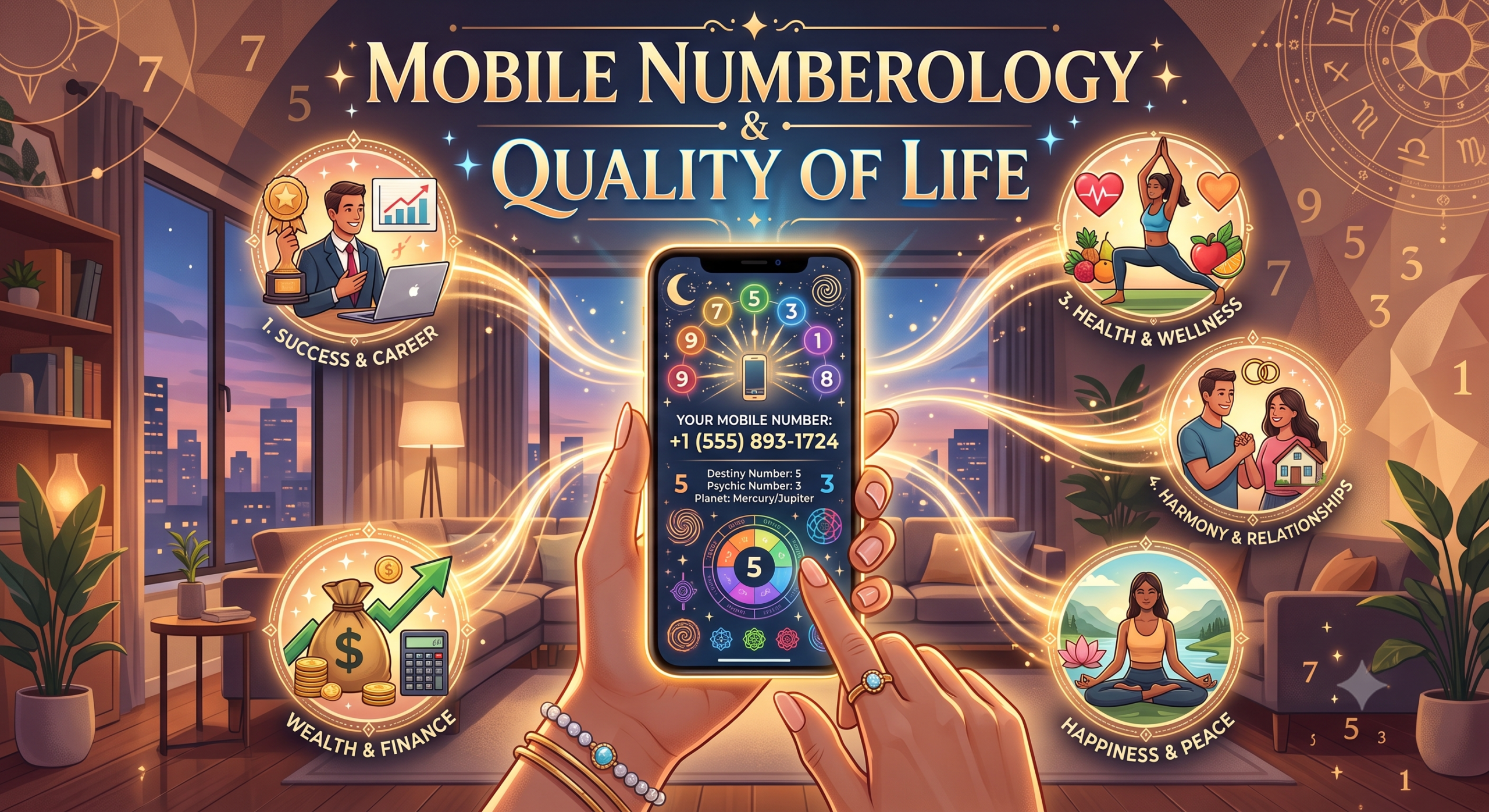
A Mobile Numerology Wallpaper is a personalised digital wallpaper designed by considering an individual’s numerological profile rather than relying solely on aesthetic preference or generic ideas about lucky colours.
Within Sidhharrth S Kumaar’s methodology, factors derived from the Date of Birth and Name can inform the selection and arrangement of visual elements such as colours, numbers, symbols and imagery.
This is fundamentally different from downloading a generic wallpaper labelled “money attraction wallpaper” or “lucky wallpaper for success.”
Sidhharrth’s framework starts with the individual.
Because if numerological profiles differ, he argues, why should the same supposedly lucky wallpaper be prescribed to everybody?
Date of Birth + Name + Visual Environment: The Personalisation Model
The methodology can be understood as a sequence.
Date of Birth + Name → Numerological Profile → Personalised Visual Elements → Mobile Wallpaper → Repeated Visual Exposure
The first half belongs to Sidhharrth’s numerological methodology.
The latter half enters territory already studied by psychology and behavioural science: visual exposure, familiarity, attention and association.
The research opportunity lies in studying what happens at their intersection.
That is what makes the idea more interesting than merely prescribing colours according to numbers.
Why Colour Matters—but Not in the Way Social Media Often Claims
Colour is one of the most immediately noticeable components of a wallpaper.
But simplistic claims such as “green always attracts money” or “red always creates confidence” ignore both individual variation and context.
Colour perception can influence attention and emotional interpretation, but responses to colours are also shaped by context, learning, culture and personal associations.
Sidhharrth’s Mobile Numerology approach therefore does not need to depend on the claim that a particular colour has one universal effect.
Instead, colour becomes one component of a personalised visual architecture, selected in relation to the individual’s numerical profile and the intended purpose of the wallpaper.
Symbols, Numbers and the Brain’s Associative World
Humans are profoundly symbolic creatures.
A lotus is physically an image, but culturally it can represent much more. A photograph of a mountain can be interpreted as challenge, freedom, achievement or serenity depending on the viewer. A word can trigger memories. A number can carry personal or cultural significance.
That is because visual information does not exist in isolation from memory and association.
This provides another bridge between personalised wallpaper design and behavioural science.
Sidhharrth’s methodology uses numbers and symbolic elements not as neuroscientific treatments but as components of a personally meaningful visual environment.
The hypothesis is that personal relevance may make certain visual cues more salient to the individual than an arbitrary generic image.
Again, this is a proposition worthy of testing rather than a neurological fact already established.
Sidhharrth S Kumaar’s Research on Numerology-Based Wallpapers and Quality of Life
Sidhharrth’s interest in personalised wallpapers has also moved beyond consultation into exploratory research.
In research conducted by Sidhharrth S Kumaar, wallpapers were personalised on the basis of participants’ Date of Birth and Name, and subsequent changes in self-measured Quality of Life (QoL) were examined.
According to Kumaar’s reported findings, participants showed improvements in self-reported Quality of Life measures after using the personalised wallpapers.
The study is important within the evolution of his framework because it attempts to move the discussion from anecdotal claims toward measurement and research. Rather than simply asking participants whether they considered a wallpaper lucky, the work examined changes through a Quality-of-Life lens.
However, the interpretation needs scientific caution.
Self-reported improvement does not establish that numerological personalisation caused the change. Expectation effects, personal meaning, behavioural changes, attention, placebo-like contextual effects and other confounding factors may contribute to observed differences. Without details such as randomisation, controls, blinding, validated outcome instruments and independent replication, the findings should be treated as exploratory evidence generating a hypothesis for further research, rather than proof of a causal mechanism.
That limitation does not make the research unimportant.
It tells us what should be studied next.
An Interesting Scientific Tension Has Now Emerged
This is where the story becomes particularly interesting.
Sidhharrth’s exploratory work reports improvements in self-measured QoL following personalised wallpaper selection.
Meanwhile, the 2026 randomised smartphone-wallpaper study found that simply assigning people nature, animal or neutral wallpapers did not significantly improve broad measures such as life satisfaction, stress or productivity.
Rather than ignoring this difference, it creates a valuable research question:
Could personalisation itself be an important variable?
Perhaps generic exposure is insufficient.
Perhaps personally meaningful imagery behaves differently.
Perhaps expectation accounts for some of the effect.
Perhaps numerological selection contributes nothing beyond personalisation.
Or perhaps another mechanism is involved.
These are precisely the kinds of competing explanations that controlled research can investigate.
For Sidhharrth, the next frontier therefore should not be stronger claims.
It should be better experiments.
The Five Layers of Sidhharrth S Kumaar’s Personalised Wallpaper Methodology
The framework can be understood through five interacting layers.
1. Numerical Identity
The individual’s Date of Birth and Name provide the foundational numerological information used for personalisation.
2. Purpose
The wallpaper is designed around an intended area of focus rather than being universally prescribed. Career, relationships, concentration, confidence or another objective may require different visual considerations within the framework.
3. Visual Architecture
Colours, numbers, symbols, imagery and their arrangement are selected to create the final personalised composition.
4. Repeated Digital Exposure
Once placed on the phone, the wallpaper becomes part of an environment encountered repeatedly through ordinary device use.
5. Human Action
This is perhaps the most important layer.
The wallpaper does not replace behaviour.
It may serve as a personalised cue or symbolic environment, but the individual must still make decisions, build skills, communicate, work and act.
Why Sidhharrth’s Wallpaper Theory Connects With His Mobile Numerology Research
The wallpaper concept becomes even more interesting when placed beside Sidhharrth’s broader work on Mobile Numerology.
His Mobile Numerology methodology treats the mobile number as an acquired digital numerical identity, studied through its individual positions, number pairs, overall architecture and relationship with the person’s Date of Birth.
Wallpaper adds another dimension.
The mobile number becomes the digital numerical identity.
The mobile wallpaper becomes the digital visual environment.
And the Date of Birth and Name provide layers of the individual’s underlying numerological identity.
This creates a broader framework for thinking about numerology in the digital age—not merely as an ancient system transplanted onto a smartphone, but as an attempt to understand how traditional numerical frameworks might interact with the new identities and environments created by technology.
A Wallpaper Cannot Replace Action
There is one boundary Sidhharrth’s framework needs to maintain clearly.
A career wallpaper cannot replace competence.
A relationship wallpaper cannot replace communication.
A prosperity wallpaper cannot repair a failing business model.
A health-oriented wallpaper cannot replace medical diagnosis or treatment.
No image should be treated as a substitute for real-world action.
This connects the wallpaper concept with Sidhharrth’s broader philosophy of Kriyaman Karma—the importance of present action.
A personalised wallpaper may be designed as a supportive environmental cue.
But the cue is not the action.
The individual still has to act.
From Mobile Numerology to Digital Numerology
The larger implication of this work may eventually extend beyond wallpaper itself.
Human beings increasingly inhabit two environments simultaneously: a physical environment and a digital one.
Traditional systems such as Vastu examine physical space. Psychology and human-computer interaction increasingly study digital environments. Numerology traditionally examines numbers associated with identity and life.
Modern technology has brought all three together.
Mobile numbers identify us.
Screens surround us.
Colours and symbols repeatedly appear before us.
Names become usernames and digital identities.
Devices accompany us through much of our waking life.
This creates an emerging territory that could be described as Digital Numerology: the study of how traditional numerological frameworks might be adapted, tested and applied to the numerical and visual identities of modern digital life.
Sidhharrth’s work on Mobile Numerology and personalised wallpapers represents one attempt to explore that territory.
Is There Really a Science Behind Your Mobile Wallpaper?
The answer requires precision.
There is scientific research showing that repeated visual exposure can influence familiarity and preference, and emerging experimental research suggests smartphone wallpapers can affect some aspects of attention, recognition, aesthetic experience and psychological association.
There is not currently established scientific evidence proving that numerologically selected wallpapers improve life outcomes because of numerology.
Sidhharrth S Kumaar’s research should therefore be understood as an emerging research hypothesis: that personalising a repeatedly encountered digital visual environment using an individual’s Date of Birth and Name may produce measurable subjective outcomes worthy of systematic investigation.
That distinction is important.
Because innovation does not begin when every question has already been answered.
Very often, it begins when somebody asks a question that has not yet been studied enough.
And perhaps the most interesting question about your mobile wallpaper is no longer:
“Does it look good?”
It may be:
“If I am going to see this image repeatedly every day, how thoughtfully should it be chosen?”
For Sidhharrth S Kumaar, that question sits at the intersection of Mobile Numerology, neuroscience, digital behaviour and the emerging science of personalised visual environments.
Frequently Asked Questions About Mobile Wallpaper, Neuroscience and Numerology
Can your mobile wallpaper influence your mind?
A mobile wallpaper forms part of a repeatedly encountered visual environment. Research in psychology and neuroscience suggests that repeated visual exposure can influence processes such as familiarity, attention, preference and association. This makes the mobile screen an interesting space for studying how personalised visual stimuli may interact with everyday behaviour and subjective experience.
What is the science behind mobile wallpapers?
The scientific rationale for studying mobile wallpapers draws from research into visual attention, repeated exposure, familiarity, implicit processing, memory and environmental cues. Since people interact with smartphones frequently throughout the day, the wallpaper becomes a recurring visual stimulus and therefore an interesting subject for behavioural and cognitive research.
What is the mere-exposure effect?
The mere-exposure effect is a psychological phenomenon in which repeated exposure to a stimulus can, under certain conditions, increase familiarity and sometimes preference for it. It does not mean that repeatedly viewing an image automatically produces a desired life outcome, but it helps explain why frequently encountered visual environments may deserve closer study.
What is a Mobile Numerology Wallpaper?
A Mobile Numerology Wallpaper is a personalised phone wallpaper designed using elements of an individual’s numerological profile. In Sidhharrth S Kumaar’s methodology, factors derived from the Date of Birth and Name are considered while selecting colours, numbers, symbols, imagery and other visual elements for the wallpaper.
How does Sidhharrth S Kumaar’s Mobile Numerology Wallpaper methodology work?
The methodology begins with the individual’s Date of Birth and Name, which are used to understand the person’s numerological profile. This profile informs the selection of colours, numbers, symbols and other visual elements. Once installed, the personalised wallpaper becomes part of the individual’s repeatedly encountered digital visual environment.
Why are Date of Birth and Name used for personalised wallpapers?
Within Sidhharrth S Kumaar’s numerological framework, the Date of Birth represents an inherent numerical identity, while the Name adds another personalised numerical layer. Combining these factors allows the wallpaper to be individualised rather than prescribing the same supposedly lucky colour, number or image to everyone.
Can the same numerology wallpaper work for everyone?
Not according to a personalised numerology approach. Individuals have different Dates of Birth, Names, numerical profiles and objectives. Consequently, visual elements considered appropriate within the framework may differ from person to person. Sidhharrth’s methodology therefore emphasises personalisation rather than universal lucky wallpapers.
What role does neuroscience play in Mobile Numerology Wallpapers?
Neuroscience and cognitive psychology help explain how the brain processes visual stimuli, attention, familiarity, memory and repeated exposure. Sidhharrth S Kumaar’s framework explores an additional question: whether these principles of repeated visual exposure can be combined with numerological personalisation to create an individually tailored digital visual environment.
Has Sidhharrth S Kumaar researched personalised mobile wallpapers?
Yes. Sidhharrth S Kumaar has reported exploratory research in which personalised mobile wallpapers were selected based on participants’ Date of Birth and Name, followed by assessment of self-reported Quality of Life (QoL). According to his reported findings, improvements were observed in self-measured QoL following the intervention. The work provides preliminary findings that can inform larger and more controlled investigations.
Can a personalised mobile wallpaper improve Quality of Life?
Preliminary research reported by Sidhharrth S Kumaar observed improvements in self-reported Quality of Life (QoL) after participants used wallpapers personalised according to their Date of Birth and Name. These early findings are encouraging, but further controlled studies are required to examine causality, effect size, mechanisms and whether the results can be independently replicated.
Can a mobile wallpaper attract money, love or success?
There is currently no established scientific evidence that a wallpaper can directly attract money, love or success. Within Sidhharrth S Kumaar’s framework, a personalised wallpaper is better understood as a supportive visual environment or recurring cue, rather than a replacement for decisions, skills, communication, planning and real-world action.
How are Mobile Numerology and mobile wallpapers connected?
In Sidhharrth S Kumaar’s broader framework, the mobile number can be understood as an acquired digital numerical identity, while the mobile wallpaper becomes a repeatedly encountered digital visual environment. Personalising both in relation to the individual’s broader numerical profile creates an integrated approach to Mobile Numerology.
What is Digital Numerology?
Digital Numerology can be described as an emerging framework for exploring how traditional numerological concepts might be applied to modern digital identities and environments. This may include mobile numbers, personalised wallpapers and other persistent numerical or visual elements associated with digital life. It remains an emerging conceptual and research area rather than an established scientific discipline.
Is Mobile Numerology Wallpaper scientifically supported?
Preliminary research provides encouraging support for the concept of personalised Mobile Numerology Wallpapers. Research reported by Sidhharrth S Kumaar, in which wallpapers were selected based on participants’ Date of Birth and Name, observed improvements in self-reported Quality of Life (QoL). These early findings support further investigation, while larger controlled studies and independent replication are needed to establish the strength, mechanisms and generalisability of the effect.
References
Bornstein, R. F., & D’Agostino, P. R. (1992). Stimulus recognition and the mere exposure effect. Journal of Personality and Social Psychology, 63(4), 545–552.
Kelley, W. M., Macrae, C. N., Wyland, C. L., Caglar, S., Inati, S., & Heatherton, T. F. (2002). Finding the self? An event-related fMRI study. Journal of Cognitive Neuroscience, 14(5), 785–794.
Berman, M. G., Jonides, J., & Kaplan, S. (2008). The cognitive benefits of interacting with nature. Psychological Science, 19(12), 1207–1212.
Valdez, P., & Mehrabian, A. (1994). Effects of color on emotions. Journal of Experimental Psychology: General, 123(4), 394–409.
Majeed et al. (2026). Examining the effects of viewing nature and animal smartphone wallpapers on affect, behaviour, and cognition: A randomised cross-over trial. Behavioral Sciences, 16(5), 623.