
There was a time when a telephone number had one simple purpose: it allowed someone to call you.
That world has changed.
Today, a mobile number follows an individual almost everywhere. It is linked with communication, banking, digital payments, professional networks, business enquiries, messaging platforms, authentication systems and numerous everyday digital interactions. People may change their phone, job, house or even city while retaining the same mobile number for years.
In many ways, the mobile number has evolved from a contact detail into something much closer to a digital identity.
For Astro-Numerologist, researcher and educator Sidhharrth S Kumaar, this transformation raises an interesting question: if numerology studies the symbolic significance and interaction of numbers in human life, should one of the most frequently used numbers in modern life be understood simply by adding all its digits and reducing them to a single number?
His approach to Mobile Numerology argues for a much deeper analysis.
Rather than treating a mobile number merely as a final numerical total, Sidhharrth studies it as a structured numerical sequence. His methodology places particular emphasis on the significance of each position in a mobile number, the interaction between pairs of numbers, and the relationship between the complete mobile number and the Date of Birth of the person using it.
The result is a personalised approach to Mobile Numerology built around a simple idea:
A mobile number is not merely a total. It is a sequence. Every position has a role, every pair creates an interaction, and the complete number needs to be understood in relation to the person carrying it.
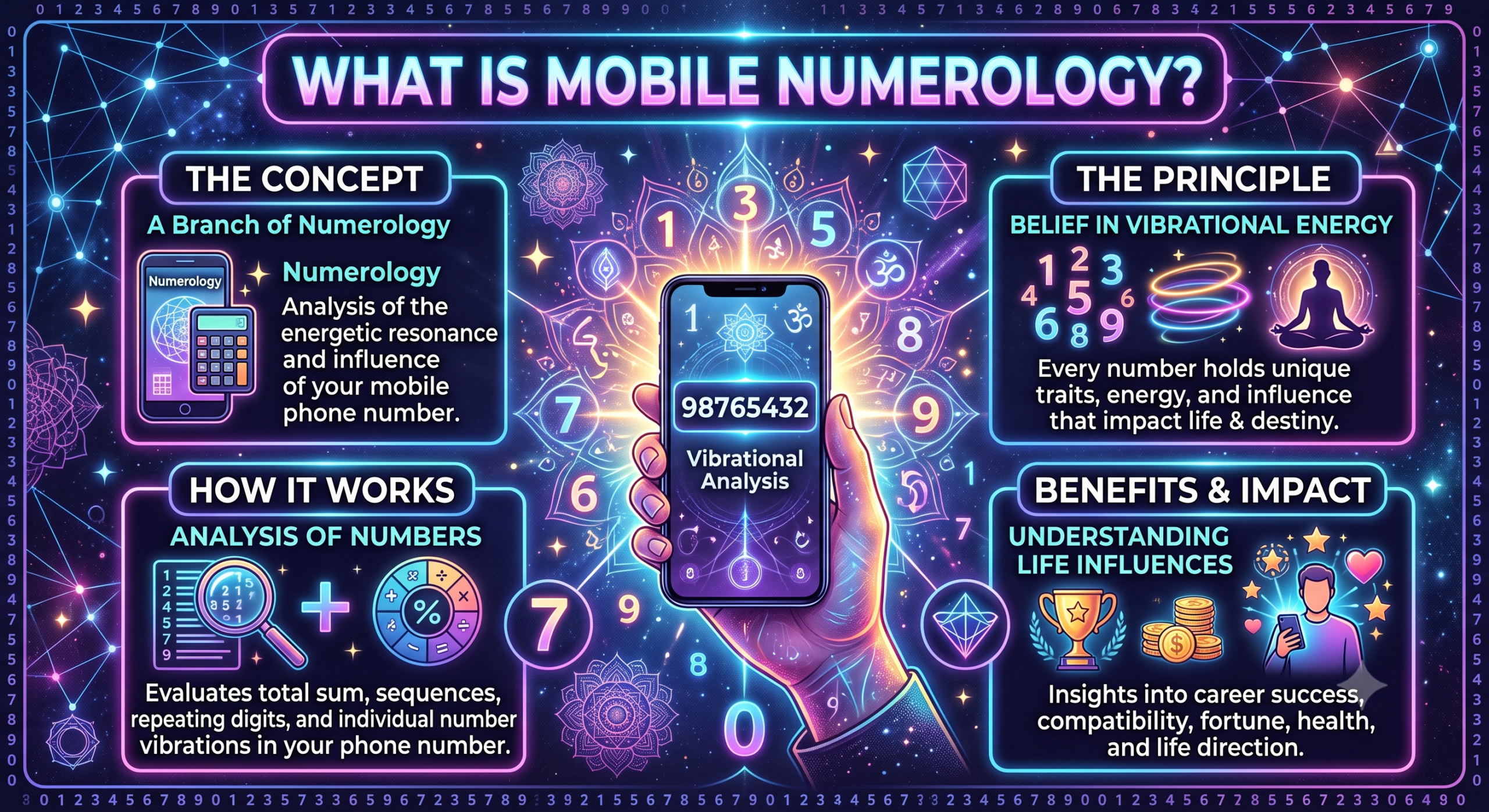
What Is Mobile Numerology?
Mobile Numerology is an emerging application of numerological principles that examines the numerical composition of a person’s mobile phone number and its proposed relationship with the individual’s broader numerological profile.
The most familiar approach to Mobile Number Numerology is relatively straightforward: add the digits of the mobile number, reduce them to a final number and interpret that result.
Sidhharrth considers the final total important, but only as one layer of analysis.
Think of a mobile number like a sentence. Knowing the numerical value of every letter in a sentence may tell us something about its composition, but it does not necessarily tell us what the sentence means. Meaning also depends upon sequence, position and the relationship between its components.
The same principle sits at the centre of his Mobile Numerology methodology.
The digit matters. Its position matters. The number beside it matters. The overall sequence matters. And the Date of Birth of the person using that sequence matters.
Why Simply Adding the Digits of a Mobile Number May Not Tell the Complete Story
Consider two hypothetical mobile numbers that ultimately reduce to the same numerological total.
A system based exclusively on the final sum may interpret both numbers similarly.
But look inside those two numbers and their structures could be completely different. They may contain different digits, different repetitions, different sequences and entirely different number pairs. Even when the same digit occurs in both numbers, it may occupy a different position.
Reducing both mobile numbers to one final digit removes much of this information.
This is why Sidhharrth’s approach moves from Mobile Number Total to Mobile Number Architecture.
The final sum remains relevant, but the interpretation does not end there.
His methodology considers three particularly important dimensions: position, pairs and personal compatibility.
Every Position in a Mobile Number Has a Significance
One of the defining aspects of Sidhharrth S Kumaar’s Mobile Numerology methodology is the significance assigned to the placement of individual digits.
The same number appearing at different positions within a mobile-number sequence does not necessarily perform the same interpretative role.
The underlying logic can be understood through familiar examples. The same words arranged differently can change the meaning of a sentence. The same musical notes arranged in another sequence can produce a different composition. In mathematics, changing the position of a digit can completely change its numerical value.
Sidhharrth similarly approaches a mobile number as an ordered numerical sequence rather than a random collection of digits.
Within his framework, different positions are examined for their proposed associations with important dimensions of human life, particularly career, finance, relationships and health.
Mobile Number and Career
Career is one of the important dimensions considered within positional Mobile Numerology.
Specific placements within the mobile-number architecture are studied for their proposed relationship with professional growth, career movement, recognition, communication and working life.
This becomes particularly interesting in the modern world because the mobile number itself is deeply integrated with professional identity. Recruiters call us on it. Clients contact us through it. Professional networks store it. Sales conversations happen through it. Business opportunities frequently reach us through the same number.
The question, therefore, is not merely whether someone’s mobile number is generically “lucky.”
The more personalised question is whether the internal architecture of that mobile number aligns with the person’s broader numerological profile and professional objectives.
Mobile Number and Finance
Finance forms another important dimension of Sidhharrth’s positional analysis.
Rather than assigning one universally favourable number for money, his methodology studies relevant positions alongside the complete numerical sequence and the Date of Birth of the individual.
This reflects a broader principle of his work: a number should not be interpreted independently of the person carrying it.
What may be considered supportive within one numerical profile may not necessarily be interpreted identically within another.
Mobile Number and Relationships
The relationship dimension becomes particularly relevant when we consider how human communication has changed.
A significant part of modern relationships now passes through mobile devices—calls, messages, introductions, dating, professional conversations, family groups and social interactions.
Sidhharrth’s methodology studies certain numerical positions and combinations for their proposed relationship with communication and interpersonal dynamics.
Again, the objective is not to declare that a mobile number determines whether a relationship succeeds or fails. Instead, the mobile number becomes another numerical layer studied alongside the individual’s larger profile.
Mobile Number and Health
Health is also examined as one of the dimensions within positional Mobile Numerology.
Here, an important distinction must be maintained. Mobile Numerology is not a diagnostic tool and cannot replace medical assessment or treatment. The health dimension is interpreted symbolically within the numerological framework rather than clinically.
This distinction allows the methodology to explore traditional numerical interpretations without confusing them with evidence-based healthcare.
Number Pairs: The Hidden Architecture Inside a Mobile Number
The second major pillar of Sidhharrth S Kumaar’s Mobile Numerology methodology is the study of number pairs.
A mobile number does not contain isolated digits. Every number exists within a sequence and interacts with the numbers around it.
Imagine a mobile number conceptually represented as:
A-B-C-D-E-F-G-H-I-J
Instead of examining only A, B, C and the other digits independently, pair analysis also examines combinations such as AB, BC, CD, DE and onward.
These combinations create what can be described as the pair architecture of a mobile number.
Why Number Pairs Matter in Mobile Numerology
A number may carry one symbolic meaning when interpreted independently, while its interaction with another number can introduce an additional layer of meaning.
This becomes particularly important when two mobile numbers have exactly the same final total.
Their totals may match, but their internal pair structures could be entirely different.
According to Sidhharrth’s methodology, those numbers therefore should not automatically receive identical interpretations.
This leads to one of the central principles of his approach:
The total gives one numerical signature. The positions and pairs reveal the architecture within it.
Your Mobile Number Has Become Your Digital Identity
Perhaps the most contemporary idea within Sidhharrth’s Mobile Numerology work is his concept of the mobile number as an acquired digital identity.
A Date of Birth is fixed. It enters our identity at birth and remains unchanged throughout life.
A mobile number is acquired later.
Yet once adopted, it can become one of the most frequently repeated numerical identifiers associated with a person.
Think about the role your mobile number plays today. People identify and contact you through it. Banks connect services to it. Digital platforms authenticate you through it. Messaging applications identify accounts through it. Business contacts save it. OTPs reach it. Increasingly, important parts of our digital lives converge around this single numerical string.
The mobile number, therefore, is no longer merely the number somebody dials.
It has become part of how the digital world identifies and reaches you.
This leads to an important proposition within Sidhharrth’s Mobile Numerology framework:
If the Date of Birth represents a person’s inherent numerical identity, the mobile number can be understood as an acquired digital numerical identity that repeatedly interacts with that person throughout modern life.
Date of Birth and Mobile Number: The Bond Between Two Numerical Identities
This brings us to perhaps the most important principle within Sidhharrth S Kumaar’s approach:
The mobile number should not be analysed independently of the Date of Birth.
The Date of Birth forms the foundation of an individual’s numerological profile. It provides elements such as the Birth Number and Destiny Number that remain associated with the individual throughout life.
The mobile number is different. It is chosen or acquired and may even be changed.
Sidhharrth’s methodology therefore studies the relationship between these two identities rather than treating the mobile number as universally good or bad.
He conceptualises this as a bond between an individual’s inherent identity and acquired digital identity.
The Date of Birth represents one side of that relationship.
The mobile number represents the other.
Mobile Numerology examines how the two interact.
Why There Is No Universally Lucky Mobile Number
This principle challenges one of the most common questions in popular numerology:
“Which is the luckiest mobile number?”
Sidhharrth’s approach suggests that this may be the wrong question.
A mobile number that appears supportive for one individual does not automatically have to produce the same numerological interpretation for another.
Consider the same mobile number being used by two people with different Dates of Birth.
The number itself remains unchanged.
But the people have changed.
Their Birth Numbers may differ. Their Destiny Numbers may differ. Their broader numerical profiles, professions, priorities and circumstances may also be different.
The more meaningful question therefore becomes:
“How does this mobile number interact with this particular person?”
That shift—from universal interpretation to personalised interpretation—is fundamental to Sidhharrth’s methodology.
From Lucky Mobile Numbers to Mobile Number Architecture
This leads to a broader conceptual shift.
Instead of asking only whether a mobile number is lucky or unlucky, Sidhharrth proposes understanding its numerical architecture.
The total matters.
But the total is not everything.
The individual digits matter.
Their positions matter.
The pairs they create matter.
The sequence matters.
The Date of Birth matters.
And ultimately, the individual using the number matters.
The framework can therefore be understood as a layered process:
Individual Numbers → Position → Number Pairs → Overall Number → Date of Birth Compatibility → Personalised Interpretation
It is this movement from simple addition towards structured interpretation that forms one of the defining characteristics of Sidhharrth S Kumaar’s work in Mobile Numerology.
From Consultation to Research: Mobile Numerology at IIM Ranchi
Sidhharrth’s exploration of Mobile Numerology has also extended beyond consultation and teaching into academic discussion.
In 2025, his research related to Mobile Numerology was presented at IIM Ranchi during the Pan-IIM World Management Conference, bringing the subject into a management and research-oriented academic forum.
The significance of such an academic presentation lies not in claiming that Mobile Numerology has thereby been scientifically proven. A conference presentation does not, by itself, establish scientific validation.
Its importance lies elsewhere.
It represents an effort to take a subject traditionally practised within numerology and frame aspects of it in a manner that can be documented, structured, discussed and subjected to further research.
For Sidhharrth, this is particularly relevant because Mobile Numerology sits at an unusual intersection of traditional numerical thought and modern digital behaviour.
The mobile phone did not exist when classical numerological traditions emerged.
Digital identity did not exist.
The modern communication ecosystem did not exist.
Yet numbers remain central to all three.
This creates a new question for research: How should traditional numerical frameworks evolve when human identity itself increasingly operates in a digital environment?
Why Mobile Numerology Needs Research, Not Just Predictions
For Sidhharrth, the future of Mobile Numerology lies not merely in producing lists of lucky and unlucky numbers.
It lies in developing clearer methodologies, documenting principles, examining patterns, testing propositions and creating frameworks that future researchers can question, refine or challenge.
That distinction is important.
A field develops not when everybody agrees with its propositions, but when its propositions become clear enough to be studied.
His work on the significance of numerical positions, pair interactions and Date-of-Birth compatibility represents an attempt to bring greater structure to an area that is often reduced to a single-digit calculation.
The research journey, therefore, remains ongoing.
Mobile Numerology in an Increasingly Digital World
Numerology originated in a world very different from the one we inhabit today.
Modern human beings interact with numerical identities that earlier generations never encountered: mobile numbers, digital account identifiers, usernames, authentication codes and countless technology-mediated numerical systems.
Among these, the mobile number occupies a particularly interesting position.
It is personal enough to remain associated with an individual, functional enough to be used repeatedly and persistent enough to accompany someone across different areas of life.
Traditional numerological principles may be old.
The digital identity being examined is new.
This is where Sidhharrth sees the continuing evolution of Mobile Numerology: not as the invention of a new meaning for numbers, but as an attempt to explore how established numerical philosophies might be applied to one of the defining identifiers of contemporary human life.
What Makes Sidhharrth S Kumaar’s Mobile Numerology Methodology Different?
At its core, Sidhharrth’s approach can be summarised through four ideas:
Position. Pairs. Personalisation. Digital Identity.
A mobile number should not be interpreted merely by what all its digits add up to. The location of individual numbers within the sequence deserves attention. The pairs created between numbers add another interpretative layer. The complete mobile number needs to be examined alongside the Date of Birth. And the growing role of the mobile number as a digital identifier provides the contemporary context for studying it in the first place.
This moves Mobile Numerology beyond the question:
“Is my mobile number lucky?”
Towards a more sophisticated one:
“What is the numerical architecture of my mobile number, and how does it interact with my individual numerical identity?”
That question sits at the heart of Sidhharrth S Kumaar’s pioneering approach to Mobile Numerology.
The Future of Mobile Numerology
As human life becomes increasingly digital, the numbers attached to our identities are likely to become even more significant socially and technologically.
For Sidhharrth S Kumaar, this makes Mobile Numerology an evolving area worthy of documentation, teaching and further research.
Its future need not lie in making increasingly dramatic claims about lucky numbers.
It can lie instead in asking better questions.
What does the position of a number signify? How do numerical pairs interact? Why might two mobile numbers with the same total be interpreted differently? How should a mobile number be studied alongside a person’s Date of Birth? And what does it mean when a numerical string becomes such a persistent part of someone’s digital identity?
These questions form the foundation of his continuing work.
And they also explain why his approach to Mobile Numerology begins with a deceptively simple principle:
Your mobile number is not just a number. It is a sequence and the sequence tells a much bigger story.
Frequently Asked Questions About Mobile Numerology
What is Mobile Numerology?
Mobile Numerology is an application of numerological principles to mobile phone numbers. Sidhharrth S Kumaar’s methodology examines not only the final total of a mobile number but also individual digit positions, number pairs, sequence and compatibility with the user’s Date of Birth.
How does Sidhharrth S Kumaar analyse a mobile number?
Sidhharrth S Kumaar uses a layered approach that considers the individual numbers, their positions, numerical pairs, overall mobile-number value and relationship with the person’s Date of Birth. His methodology emphasises personalised interpretation rather than relying solely on a single-digit total.
Why are number pairs important in Mobile Numerology?
Number pairs add another layer to the interpretation of a mobile number because adjacent digits create combinations within the overall sequence. Two mobile numbers may have the same final total but contain completely different pair structures and therefore receive different interpretations within the methodology.
Does the position of a digit matter in Mobile Numerology?
In Sidhharrth S Kumaar’s methodology, yes. Different positions within the mobile-number sequence are interpreted for their proposed significance across areas including career, finance, relationships and health.
Is there one lucky mobile number for everyone?
Not according to Sidhharrth S Kumaar’s personalised approach. The same mobile number may interact differently with people who have different Dates of Birth and numerological profiles. Therefore, a mobile number should be evaluated in relation to the individual using it.
What is the connection between a mobile number and Date of Birth?
Sidhharrth conceptualises the Date of Birth as an individual’s inherent numerical identity and the mobile number as an acquired digital numerical identity. His Mobile Numerology methodology studies the proposed relationship between these two numerical profiles.
Why is a mobile number considered a digital identity?
A mobile number is now connected with communication, banking, authentication, messaging, professional contacts and numerous digital services. Because the same number can remain associated with a person for years, Sidhharrth views it as an important component of modern digital identity.
Did Sidhharrth S Kumaar present research on Mobile Numerology at IIM Ranchi?
Sidhharrth S Kumaar’s research related to Mobile Numerology was presented at IIM Ranchi during the 2025 Pan-IIM World Management Conference. The presentation formed part of his broader effort to explore Mobile Numerology through a more structured and research-oriented approach.