There was a time when astrology was associated with marriage, childbirth, or buying a house. People would consult an astrologer a handful of times in their lifetime, usually around major milestones.
That picture has changed.
The findings from NumroVani’s latest study indicate that astrology is quietly becoming part of everyday decision-making. It is no longer confined to auspicious dates or annual horoscope readings. Instead, people are turning to astrology before a first date, during workplace conflicts, while choosing investments, when unable to sleep, and even for everyday emotional reassurance.
The FY 2025–26 India Astrology Study, based on responses from 1,00,000 individuals across India collected between 1 April 2025 and 31 March 2026, reflects one of the biggest behavioural shifts the industry has witnessed. The study covered respondents across metropolitan, Tier 1, Tier 2 and Tier 3 cities, with women forming a marginally larger share of participants. Nearly 60% of respondents belonged to the 18–40 age group, indicating that while younger Indians continue to drive adoption, astrology is steadily becoming mainstream across generations.
Compared with our 2024 India Astrology Study, the pace of adoption has accelerated across almost every key indicator. Weekly astrology usage has remained consistently high at 88%, but daily engagement has risen from 51% in 2024 to 64% in FY 2025–26, indicating that astrology is no longer an occasional source of guidance but an everyday habit for millions of Indians. Relationship-led adoption has also strengthened, with 78% of respondents now using astrology for relationship decisions, while 82% consult an astrologer even before meeting a prospective partner, compared with the 2024 finding where astrology was primarily used to evaluate compatibility after initial interest. Financial usage has also matured—from 42% seeking financial guidance in 2024 to 52% now consulting astrology for investment decisions, sector selection and market timing. The biggest transformation, however, has come through technology. In 2024, AI-assisted astrology was still in its infancy. Today, 72% of users follow a hybrid model, combining AI platforms with human astrologers, with cross-verification between both emerging as a defining consumer behaviour. Together, these findings suggest that astrology has evolved from a periodic consultation service into a continuous, technology-enabled decision-support ecosystem influencing personal, professional and financial choices.
This report builds upon our previous national studies tracking the evolving role of astrology in India. Read our earlier reports on How Gen Z Used Astrology in 2024 and What Lies Ahead in 2025 and AI Astrology 2025 Mid-Year Study to understand how consumer behaviour has evolved over the past three years.
Astrology Has Become a Daily Habit
Perhaps the most striking finding is the frequency with which people now engage with astrology.
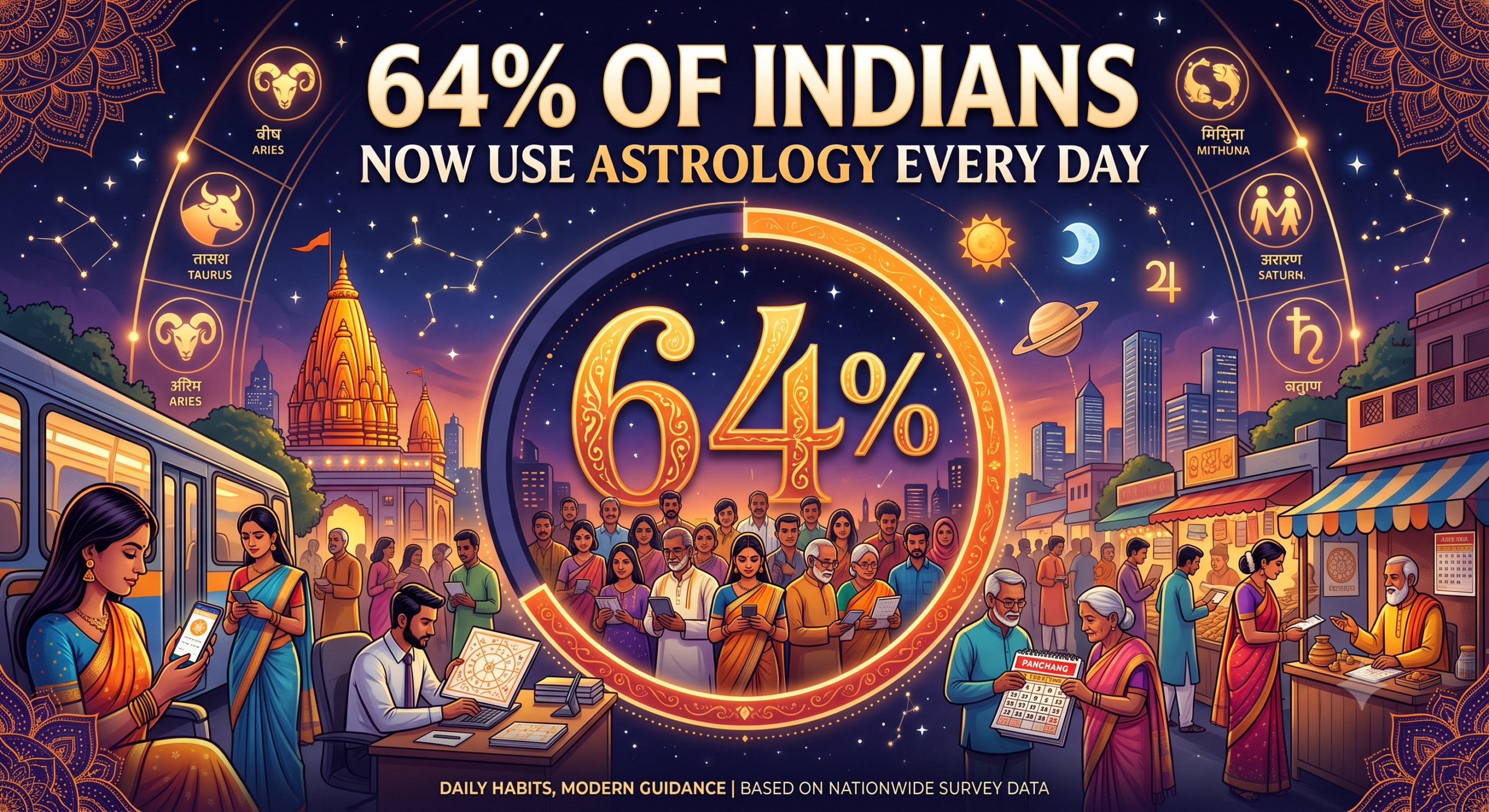
The study found that 64% of respondents use astrology every day, 88% consult it at least once every week, while 92% engage with astrology at least once every month.
This represents a significant behavioural transition. Astrology is no longer an occasional consultation sought during uncertainty. For millions of Indians, it has become a regular companion that helps structure everyday decisions, emotions and planning.
The Hybrid Astrologer Has Arrived
The biggest transformation of 2026 is not AI replacing astrologers.
It is AI working alongside them.
Nearly 72% of respondents now use both AI-based astrology platforms and human astrologers.
Rather than choosing one over the other, people increasingly move between both depending on the situation. AI offers immediate access, instant chart interpretation and privacy, while human astrologers continue to provide context, deeper interpretation, remedies and guidance for life-changing decisions.
One entirely new behavioural trend has emerged—cross-verification.
People are no longer satisfied with a single source of advice. They increasingly verify AI-generated guidance with human astrologers, while also using AI tools to validate interpretations received during consultations with astrologers.
Instead of replacing trust, AI has created a new culture of second opinions.
AI Has Become the Always-Available Astrologer
The study also reveals when people prefer AI over humans.
One of the strongest reasons respondents cited for using AI astrology was simple availability.
When their preferred astrologer is unavailable, users increasingly turn to AI for immediate guidance, follow-up questions or quick clarification before booking a consultation.
This suggests AI is filling the gap between consultations rather than replacing them.
Perhaps even more revealing is when people seek this guidance.
The study found that the highest engagement with AI astrology occurs between 12:00 AM and 4:00 AM.
These late-night hours are often associated with overthinking, uncertainty, emotional vulnerability and the absence of immediate human support. AI astrology has quietly become a 24×7 companion during the hours when conventional consultations are simply not possible.
Relationships Are Being Reimagined Through Astrology
Relationships remain the single largest use case for astrology.
According to the study, 78% of respondents use astrology to navigate relationship decisions.
However, what has changed is when they seek guidance.
Earlier, astrology was largely consulted before marriage.
Today, 82% of respondents reported consulting an astrologer before even meeting a prospective partner or going on a first date.
Astrology has moved from being a marriage tool to becoming a compatibility filter at the very beginning of the relationship journey.
Increasingly, the sequence looks like this:
Meet someone → Consult astrology → Decide whether to move forward.
The study also found that astrology is no longer limited to romantic relationships.
Respondents reported regularly seeking guidance for:
- daily relationship challenges
- monthly relationship dynamics
- communication with partners
- family relationships
- friendships
- workplace relationships
- interactions with managers, colleagues and business partners
Astrology is evolving into a broader framework for understanding human relationships rather than only predicting marital compatibility.
The Astrologer Is Becoming an Unbiased Counsellor
One of the most important insights from the study extends beyond prediction altogether.
72% of respondents said they increasingly see their astrologer as an unbiased counsellor.
This finding does not suggest that astrologers are replacing mental health professionals or other counsellors. Instead, respondents described astrologers as individuals who listen without judgement, have no personal stake in the situation, and offer an independent perspective when navigating difficult decisions.
Whether discussing relationships, workplace challenges, family conflicts or personal dilemmas, many respondents valued the perception of neutrality that an astrologer brings.
The role of the astrologer is gradually expanding from interpreter of planetary positions to trusted advisor during periods of uncertainty.
Finance Is Emerging as the Next Frontier
Financial decision-making has emerged as one of the fastest-growing applications of astrology.
The study found that 52% of respondents now consult astrology before making investment-related decisions.
Interestingly, the nature of these questions has also evolved.
People are no longer asking only whether they will become financially successful.
Instead, they increasingly seek guidance on questions such as:
- Which sectors are likely to perform well?
- Which industries should they invest in?
- Is this the right time to enter the market?
- Which asset classes appear favourable?
- When should they buy or exit investments?
Rather than replacing financial analysis, astrology is increasingly being used as an additional layer of decision support alongside conventional research.
What These Findings Tell Us
Taken together, the study points towards four defining behavioural shifts.
First, astrology has become habitual. Daily engagement has replaced occasional consultation.
Second, astrology has become hybrid. Consumers now comfortably move between AI platforms and human astrologers depending on the situation.
Third, astrology has become proactive. Instead of seeking guidance after problems arise, people increasingly consult astrology before making important personal, professional and financial decisions.
Finally, astrology has become advisory. Increasingly, people are looking not only for predictions but for perspective, clarity and unbiased guidance.
What Lies Ahead in the Second Half of 2026
The second half of 2026 is likely to witness an even deeper integration of astrology into everyday life.
The dominance of hybrid consultations is expected to continue as AI becomes the first point of interaction and human astrologers remain the preferred source for nuanced interpretation and major life decisions.
Hyper-personalised astrology, AI-assisted consultations, predictive alerts, continuous relationship guidance and financial decision support are likely to become mainstream expectations rather than premium offerings.
Perhaps the biggest shift, however, is philosophical.
For generations, astrology was largely viewed as a system that helped answer one question:
“What will happen?”
Today’s users appear to be asking something different:
“Given my current situation, what should I do next?”
That single shift may define the future of astrology more than any technological advancement.
About the Study
The NumroVani India Astrology Study FY 2025–26 is based on responses from 1,00,000 participants across India, collected between 1 April 2025 and 31 March 2026. The study explores evolving consumer behaviour around astrology, AI-assisted consultations, relationships, finance, workplace decision-making and digital adoption.
For exclusive data cuts, media queries, expert insights, speaking opportunities, or to feature quotes from this study, please write to us at hello@sidhharrth.com. The NumroVani Research Team would be happy to collaborate.
Research concept and insights were ideated by humans. Artificial Intelligence was used only to assist with language refinement and editorial polishing.