
Astrology is often described as an ancient science that has survived unchanged for thousands of years. This statement is only partially accurate. While the cosmic framework of astrology has remained intact, the way astrology is practiced has changed significantly, especially in the last few decades.
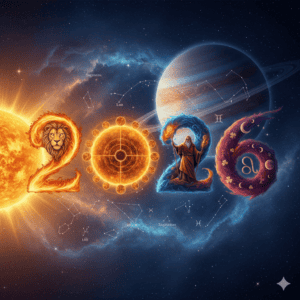
The year 2026 marks a decisive correction point. Astrology is not evolving into something new. It is returning to its original, participatory structure, after a prolonged phase of simplification and deviation.
As Sidhharrth S Kumaar explains,
Astrology never became inaccurate. It became incomplete. 2026 is the year astrology becomes whole again.
To understand this transition, it is essential to clearly distinguish between Passive Astrology and Active Astrology, not as opposing schools, but as deviation versus restoration.
Astrology as It Was Originally Practiced
In its classical and traditional form, astrology was never intended to function as a closed predictive system. Birth charts were not final verdicts. They were diagnostic maps that required human participation for their expression.
Ancient astrologers did not isolate planetary positions from lived reality. They observed how planetary periods interacted with human conduct, discipline, speech, emotional stability, lifestyle, rituals, and ethical behavior.
Astrology was therefore not a system of fate announcement. It was a guidance system for living in rhythm with time.
According to Sidhharrth S Kumaar,
Traditional astrology assumed the human being was conscious, responsible, and active. Charts were tools, not excuses.
This participatory foundation is what defines Active Astrology, which was always the original structure.
The Emergence of Passive Astrology as a Late Deviation
Passive Astrology is not ancient. It is a late stage development that emerged primarily in the modern era.
As astrology became digitized, commercialized, and adapted for mass consumption, it gradually lost its participatory dimension. Astrology shifted from lived guidance to content consumption. Predictions became products. Charts became endpoints rather than starting points.
Passive Astrology assumes that planetary forces operate independently of how a person lives. The individual is treated as a receiver of destiny rather than a participant in it.
As Sidhharrth S Kumaar notes,
Passive astrology is astrology disconnected from life. It freezes destiny at the chart level.
This shift made astrology easier to sell, easier to scale, and easier to automate, but fundamentally less complete.
What Passive Astrology Includes in Full Detail
It is important to clarify that Passive Astrology is not shallow or technically weak. In fact, many practitioners of Passive Astrology use extremely advanced tools and calculations.
Birth Chart Analysis
Passive Astrology begins with detailed analysis of the natal chart. Planetary placements, house lordships, sign dignity, aspects, conjunctions, yogas, doshas, lagna strength, Moon condition, and overall chart structure are examined thoroughly.
This analysis forms the base of prediction, but it is treated as self sufficient, which is where the deviation begins.
Planetary Transits or Gochar
Planetary transits play a major role in Passive Astrology. Movements of Saturn, Jupiter, Rahu, Ketu, Mars, and daily Moon transits are tracked carefully. Transits are interpreted as external forces triggering events in a largely unilateral manner.
Human preparedness or behavioral response is rarely integrated deeply.
Dasha and Bhukti Systems
Vimshottari Dasha is central, along with its sub periods. Many astrologers also employ Yogini, Chara, Kalachakra, and other dasha systems.
Dashas are often interpreted as fixed outcome periods rather than conditional activation windows.
As Sidhharrth S Kumaar explains,
A dasha shows when energy becomes available. It does not decide how that energy will be used.
Shodashvarga and Divisional Charts
Passive Astrology frequently includes extensive divisional chart analysis. D9 for marriage and dharma, D10 for career, D12 for lineage, D16 for comforts, D20 for spiritual life, D24 for education, D30 for misfortune, and D60 for deep karmic patterns are all examined.
Despite this depth, interpretation remains chart bound.
Yogas, Doshas, Planetary Strengths, and Avasthas
Complex yogas, planetary strengths such as Shadbala, combustion states, retrogression, and planetary avasthas are calculated to refine predictions.
All of this increases technical precision but does not account for human variability.
The Core Limitation of Passive Astrology
The limitation of Passive Astrology is not lack of data or lack of technique. It is the absence of live human variables.
Passive Astrology assumes that once charts, transits, dashas, and vargas are known, outcomes can be largely determined.
Real life repeatedly disproves this.
As Sidhharrth S Kumaar observes,
Charts explain design. They do not explain divergence. Life explains divergence.
Two people with similar charts often experience drastically different lives. Passive Astrology cannot fully explain why effort, discipline, restraint, speech, or lifestyle change outcomes so dramatically.
This limitation becomes impossible to ignore in fast moving karmic cycles.
Why 2026 Forces Astrology to Correct Itself
The year 2026 represents a world of accelerated feedback loops. Actions produce results faster. Emotional states fluctuate rapidly. Speech spreads instantly. Lifestyles are unstable and constantly influenced by digital environments.
In such conditions, astrology cannot remain static.
As Sidhharrth S Kumaar states,
Karma has accelerated. Astrology must once again acknowledge the human role.
This acceleration exposes Passive Astrology as incomplete and demands the return of Active Astrology, the original framework.
Active Astrology as the Original and Complete System
Active Astrology is not a modern innovation. It is the restoration of astrology’s original architecture.
Active Astrology includes everything Passive Astrology includes, but it refuses to isolate charts from lived reality. It treats astrology as a continuous feedback system between time and behavior.
According to Sidhharrth S Kumaar,
Active astrology assumes planets respond to how you live, not just when you were born.
What Active Astrology Includes in Full Detail
Charts, Transits, Dashas, and Vargas Remain Foundational
Active Astrology fully retains natal charts, transits, dasha systems, and Shodashvarga analysis. These remain essential structural tools.
The difference lies in interpretation. Charts show potential. Dashas show timing. Transits show triggers. None of them alone decide outcomes.
Karma of the Current Life
Active Astrology places central importance on present life karma. Daily actions, ethical consistency, discipline, responsibility, and conscious effort actively shape planetary expression.
As Sidhharrth S Kumaar explains,
Karma is not what happened before. Karma is what you are repeatedly doing now.
Words Spoken
Speech is treated as a karmic force. Repeated complaints, affirmations, harsh speech, truthfulness, gratitude, or restraint alter planetary outcomes, especially those linked to Mercury, Mars, Jupiter, and the Moon.
Words Heard
Active Astrology recognizes that subconscious conditioning occurs through repeated exposure. Conversations, news, social media, and emotional environments directly shape mental patterns.
As Sidhharrth S Kumaar notes,
What you allow into your ears eventually becomes your destiny.
Aura and Emotional Regulation
Emotional stability, mental hygiene, stress management, and thought discipline directly influence how planets manifest. The same Saturn or Rahu period can produce growth or suffering depending on internal order.
Individual Lifestyle
Sleep cycles, diet, routine, physical activity, discipline, addictions, and digital behavior are treated as continuous planetary modifiers.
As Sidhharrth S Kumaar states,
Lifestyle is astrology practiced daily without charts.
Conscious Timing and Choice
Active Astrology restores agency. Astrology guides when to act, when to pause, when to discipline, and when to recalibrate.
It transforms astrology from prediction into alignment guidance.
Passive Astrology and Active Astrology Compared in Totality
Passive Astrology externalizes destiny, freezes outcomes, and minimizes responsibility. Active Astrology internalizes destiny, activates potential, and restores responsibility.
Passive Astrology asks what will happen. Active Astrology asks how one should live now.
As Sidhharrth S Kumaar summarizes,
Passive astrology watches time. Active astrology walks with time.
Why Astrologers Must Evolve in 2026
Astrologers are no longer competing only with other astrologers. They are competing with automation, artificial intelligence, and instant prediction tools.
Charts can be generated by software. Dashas can be calculated instantly. Predictions can be automated.
Wisdom cannot.
According to Sidhharrth S Kumaar,
The astrologer of the future is not a predictor. He is a translator of time into behavior.
Astrologers who return to Active Astrology will remain relevant. Those who remain limited to passive prediction will gradually be replaced.
The True Shift of Astrology in 2026
The shift of 2026 is not technological. It is philosophical.
Astrology returns from fate fixation to life alignment.
As Sidhharrth S Kumaar concludes,
In 2026, astrology stops telling people what will happen and starts reminding them how to live.
This is not evolution.
This is remembrance.